







-

Jeff Kassouf

If the 2027 Women’s World Cup seems far away, think again.
Now that the U.S. women’s national team has won the 2026 edition of the SheBelieves Cup, head coach Emma Hayes has only six more international windows until she needs to name her World Cup squad.
Hayes has begun to narrow the USWNT player pool in recent months. As she and her staff refine their tactics, one of the big questions over the next 15 months endures: Who will Hayes count on as her starting lineup when the tournament kicks off in Brazil?
Hayes has ushered in a historic level of experimentation over the past year-plus: 32 international debuts in her first 32 games at the helm, by far more than any other USWNT coach in that same span. But that makes it all the more difficult to determine what even is her preferred lineup.
We’re up for the challenge, but first, a nota bene about nuance: A “preferred” lineup begs the question, “Preferred against whom?” Hayes said as much last week when she spoke repeatedly about getting this new group of players ready for “tournament football,” where games must be won in different ways.
– USWNT seals SheBelieves Cup title with Alyssa Thompson goal
– Kassouf: Hayes’ USWNT vision for 2027 World Cup is becoming clear
– Women’s Asian Cup talking points: Why North Korea’s Choe is must-watch
“What I know is that we have to keep building our connections as much as possible,” Hayes said on Friday. “I’ve made it clear this year that there will be, particularly in three-game windows, two teams, per se, that will play — maybe not all of the time — but so we get a chance to develop the connections for a group of players over two games; in one group, over one of the games. That, for me, is the bigger priority.”
World Cup group stages typically feature a wide range of opponent qualities and styles, meaning there are planned rotations within those games and a “strongest” starting lineup will mean two different things against two different opponents. For example: A group stage game against a low-ranked team that is expected to sit low would call for an aggressive midfield, but a match a few days later against a world heavyweight could require a double pivot and more defensive cover.
Those opponents will not be known until at least the World Cup draw, which is likely to take place at the end of this year. And a lot is bound to happen between now and the 2027 World Cup from a roster perspective, from injuries and comebacks to dips in form.
With those acknowledgements established, let’s look at what Hayes’ World Cup lineup could look like come June 2027, using everything we know about her choices to date and the ideologies she has laid out to form our hypothesis. To be clear, this is not who we’d pick — this is how we think Hayes is thinking.
The post-Alyssa Naeher era has shaped up as a two-horse race between Tullis-Joyce and Dickey. They have received roughly equal playing time over the past year, with Tullis-Joyce’s brief injury absence in the fall factoring into their total caps.
This race is hardly decided, but Tullis-Joyce impressed in her debut against Brazil and earned the start in the ostensible showcase game of the SheBelieves Cup against Canada. Hayes has talked about the development she has seen from Tullis-Joyce with the ball at her feet and as a vocal leader.
Dickey is equally worthy of the starting role for her stupendous shot-stopping (half-jokingly dubbed “The Claw” by Seattle Reign teammates) and could still claim the starting spot. Reading the tea leaves as best we can from the outside, Tullis-Joyce seems to have the inside position.
Barring injury, Girma, at center back, and Fox, at right fullback, are locks. Each is among the best in the world at her respective position.
That opposite fullback is one of the big questions about this back line. Patterson has an exceptional combination of game awareness and athleticism and could still be the answer. Gisele Thompson can claim similar attributes, plus the X factor of the unspoken connection with her sister, Alyssa.
Reale, however, looks to have the inside track on the position. She, too, can push high to join the attack like Gisele Thompson, and she has a tough-as-nails defensive stature like Patterson. Reale thrived for Gotham FC last year, helping the team win the NWSL Championship and Concacaf crown while collecting NWSL Rookie of the Year honors.
An even bigger question looms around Girma’s central partner, and the player who can’t be forgotten in that discussion is Davidson, who tore an ACL nearly a year ago. The Girma-Davidson combination was Hayes’ preference (but for a minor injury to Davidson) at the 2024 Olympics, where the USWNT won the gold medal. The problem is they have played together only once since then due to injuries, the most serious of which was Davidson’s torn ACL — a second in three years and a concern in itself.
Davidson was just reactivated by Gotham and reappointed as club captain ahead of the 2025 season. She is naturally left-footed and a clear complement to Girma. Health and durability will be her greatest questions, but she has over a year to reintegrate.
In the meantime, the omnipresent and ever reliable Sonnett continues to deliver at center back. It is entirely possible that Sonnett starts next to Girma at the World Cup.
Tara Rudd’s stock also continues to rise as a more aggressive center-back option after coming off the bench against Colombia and shutting down the electric Linda Caicedo in several one-vs-ones.
Peak Lavelle season has been upon us for the past year. Lavelle might be the first name on the team sheet if her current form — and, as ever, her good health — persists. The USWNT does not have a like-for-like replacement for Lavelle, who, as Canada coach Casey Stoney admitted after Wednesday’s 1-0 USWNT victory, forces opponents to adjust.
Coffey is also a shoo-in for the holding midfielder role, whether in a double or single pivot. Her game continues to evolve alongside her leadership, and her recent move to Manchester City will only add layers to her already superlative game. Together, Coffey’s deep-lying abilities and Lavelle’s smooth attacking provide a yin and yang in the midfield.
Who balances them out, and how, becomes a tension point for Hayes.
Heaps is the team’s captain and its most experienced player, one whose technical and tactical acumen remains undervalued by the wider public. She will be 33 when the World Cup kicks off, a relative outlier on a team suddenly composed of 20-somethings. There are valid questions to ask about durability, but that’s also why Hayes is developing depth.
The Coffey-Heaps-Lavelle midfield is still an option. Yes, this trio was bypassed at times during that Olympic gold medal run. And yes, status quo seems like an unusually safe play for a disruptor like Hayes.
But two things are at play here: First, Hayes is likely to lean into veterans down the spine of the team, a concept she has discussed in the past. Second, increased depth means Heaps (and Lavelle and Coffey, for that matter) should find a pocket of rest at the World Cup, at least with a favorable draw.

3:05
Is Lindsey Heaps USWNT’s most important player?
The “Futbol Women’s” crew discuss Lindsey Heaps’ stunning performances so far for USWNT in the SheBelieves Cup.
Former USWNT coach Jill Ellis did this successfully at the 2019 World Cup, swapping all 10 outfield players in the second group game to manage a roster of veterans and plan for the knockout stage.
Yohannes, who will have just turned 20 before the World Cup, is the most technically gifted of the up-and-coming midfielders. Hayes spoke again this past week about developing combinations of players in her game rotations, and Heaps and Yohannes, who are currently teammates at OL Lyonnes, are naturally symbiotic.
Yohannes is a sublime talent with exquisite vision who will probably start for the next decade. Hutton, in a more defensive-minded role, looks to be the other long-term midfield foundation for the USWNT. Both Yohannes and Hutton look on track to start some games at the World Cup when the situation calls for it.
[Deep exhale] Decisions on the front line are why Hayes earns the big bucks (the “highest-paid women’s soccer coach in the world,” per U.S. Soccer at the time of her hiring; over $1 million annually, per sources at the time).
Wilson and Swanson are in their return-to-play programming after giving birth, and the self-proclaimed Triple Espresso — with Rodman now back on the field after injuries — could be reunited come 2027. Surely, Hayes will want that, right?
Yes … and no. Hayes can’t ignore that Alyssa Thompson is her most consistent, in-form winger, having now split time between tearing up NWSL and Women’s Super League defenses over the past year. The 21-year-old has an indisputable ability to dribble at defenders with speed and catch teams in transition. She’s undroppable right now.
Rodman, so long as she stays healthy, is similarly unique. She brings an X factor of creative flair and swagger to this team, a torchbearer of confidence at any moment. She has an innate nose for the goal.
That leaves the No. 9 role for the taking. Macario staked her claim to it in 2025, but Wilson will do the same this year as she returns from maternity leave. Who earns the World Cup starting role will be less of an indictment of either player’s qualities and more of a referendum on how Hayes wants to play.
Macario is a back-to-goal false 9 who loves to combine. Wilson will stretch defenses and run at defenders. Wilson is also going to add an element of defensive pressure high up the field. One might be great for a certain opponent, and the other might make sense in a different match.
The good news in such a scenario? Imagine bringing any of Swanson, Wilson, Macario or Alyssa Thompson off the bench. And then there are Shaw and Sentnor, who can each play across the front four positions.
The USWNT’s World Cup lineup(s)
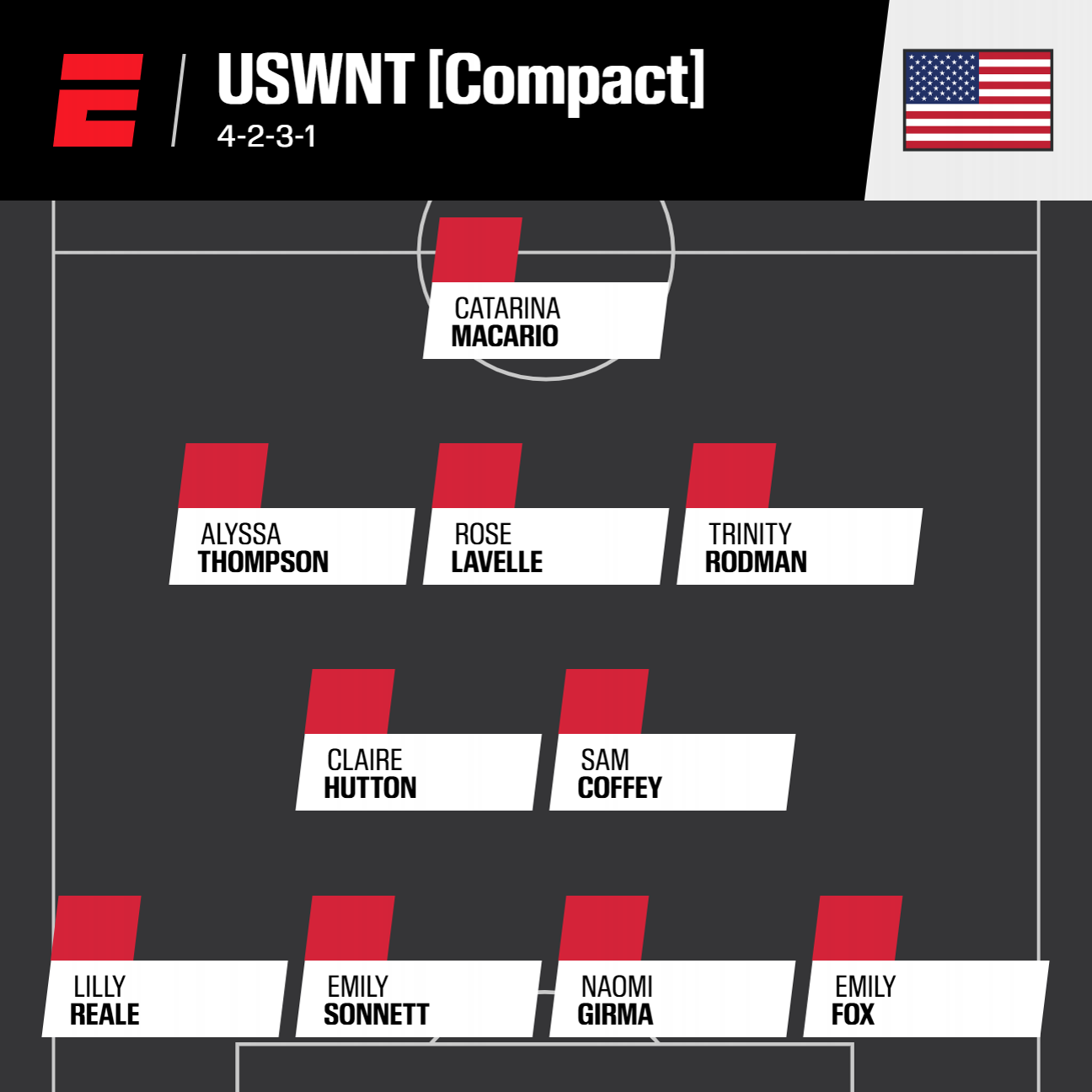
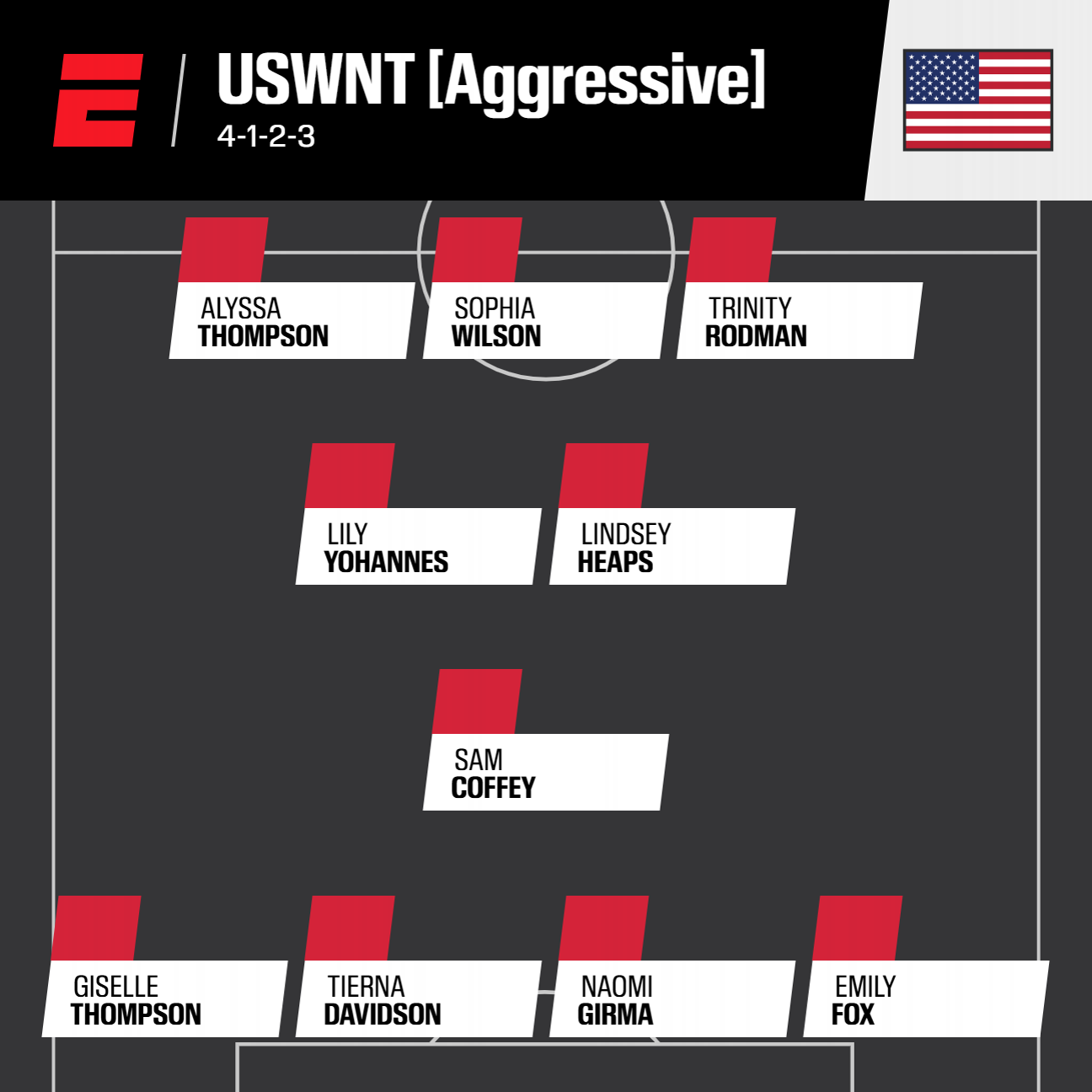

So, what does all that mean for the World Cup?
The USWNT’s “best XI” is more like finding the right combination in the right game from a pool of 15 or so players.
You can see what we predict the lineup could look like if the USWNT takes an aggressive disposition (as it did recently against Argentina), and if Hayes feels she needs more cover in a more heavyweight match — two recent Canada fixtures are tangible examples.
In the aggressive model, Yohannes has the freedom to distribute and be a playmaker (as she did against Italy recently) without the USWNT worrying too much about getting counterattacked.
In the more compact model, Hutton and Coffey are a double pivot with Lavelle as the playmaker (a relatively frequent combination over the past year), Reale is the more conservative fullback, and Alyssa Thompson and Rodman are tasked with getting in behind as Macario pulls defenders out of position.
Whichever approach the USWNT goes with, expect Tullis-Joyce to be in goal as the No. 1.