






Mewgenics is a strategy RPG rogue-lite with fighting cats. As a general fan of the strategy RPG genre, and the developer’s previous games, I was curious to try it out. A killer soundtrack and interesting game mechanics make it worth the price of entry alone, but it overstayed its welcome in the end compared to other RPGs I’ve played recently.
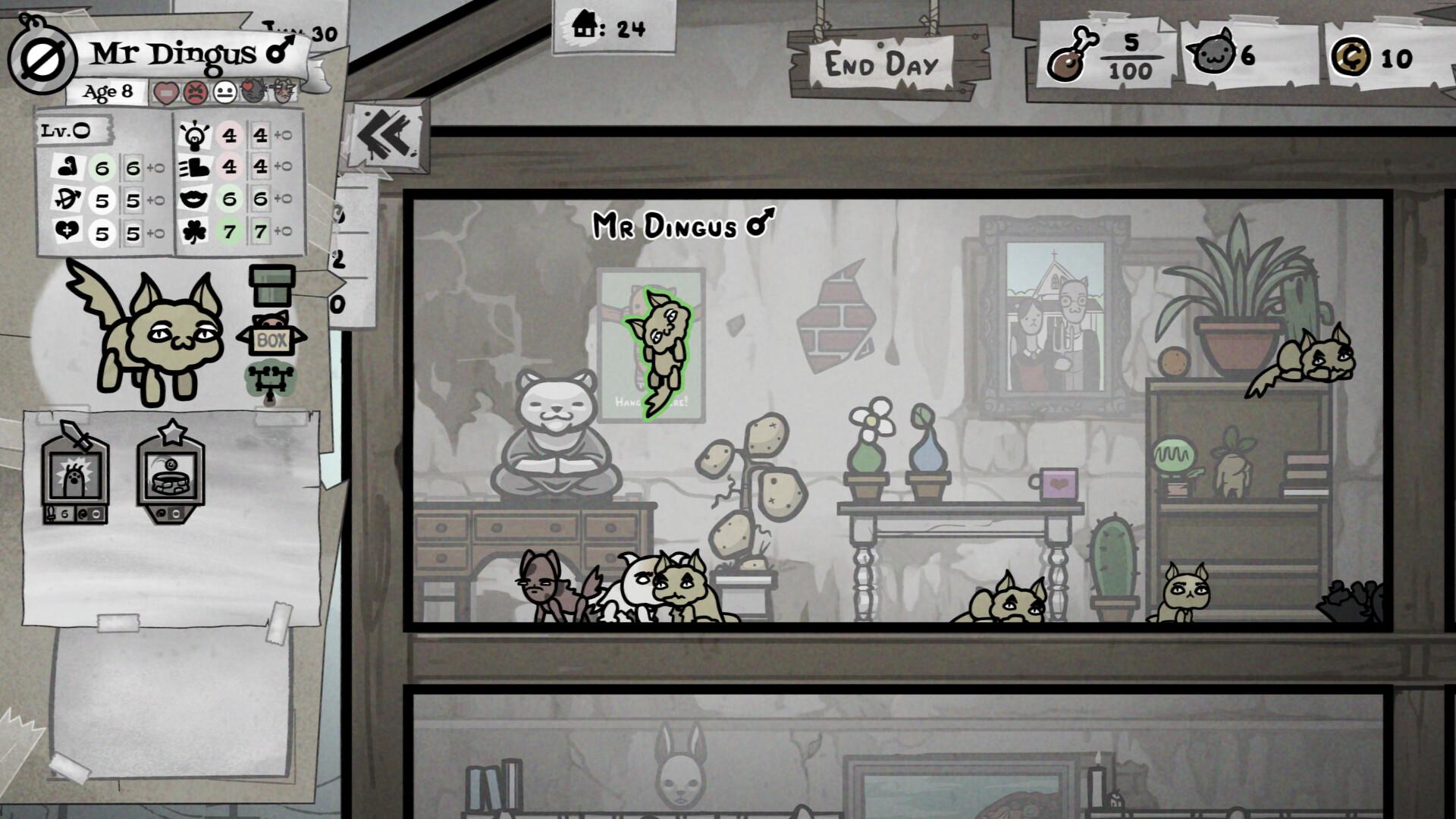
The general game cycle splits between cat management and battles. The management side is a house with cats that you can split up into different rooms. Every day a single stray is available that you can take into your house or leave out in the cold. Once you’re done with a day (there’s often not much to do, so these can go quite quickly), your cats eat a certain amount of food from your stockpile and every night there is a chance that your cats will fight or make kittens. While playing from the house, you can visit a few NPCs, who can be upgraded by giving them cats with particular qualities. For instance, one NPC wants only kittens, and they’re a great way to get rid of any undesirables or if you’re growing your cat crew more than you can manage. Upgrading these NPCs can improve what’s available at different stores, how many items you can keep in storage, or give you access to more information (such as which of your cats are more likely to fight with others).
One of my favorite parts of Mewgenics was slowly improving my cats. With each generation the stats of the two parents are mixed and if you get lucky you can get the best of both worlds. The house can also be adorned with furniture to improve the quality of strays or kittens, increase the chance that your cats will be lovers instead of fighters, or increase the chance that your cats will mutate into new and interesting forms. Examples of these mutations include longer legs that avoid traps, or eyestalks that damage enemies when they’re contacted. Most of the mutations come with an increase of one stat by two and decrease of another by one. After a while you can see so much about each cat that it’s possible to direct the kinds of kittens you get to be better and better. Admittedly, I felt a little weird about participating in eugenics as the game’s title suggests, but animal husbandry has been doing this kind of thing for thousands of years, so it was more a bemusing thought than a guilt.
You won’t be able to get too comfortable on this side of the game, however, because you’ll quickly start to run out of food, or money, or both. This is where the strategy RPG rogue-lite element comes into play. Four cats can be chosen to send out on an adventure, where they’ll fight on a grid against various enemies, earn food and money, and level up as they go. Before you can get to that you have to choose often D&D-inspired classes for each of your cats. These range from standard ones like clerics and fighters, to more specialized classes you unlock with time. The choice of class impacts each cat’s base stats, as well as its move sets. I never decided on the best way to choose which cats got which class, and whether to use those stat increases to shore up their weaknesses or to lean into the strengths. Either way, it was fun to experiment for a bit, but I found myself gravitating to what works reliably, as I didn’t want to waste a run on a lark.
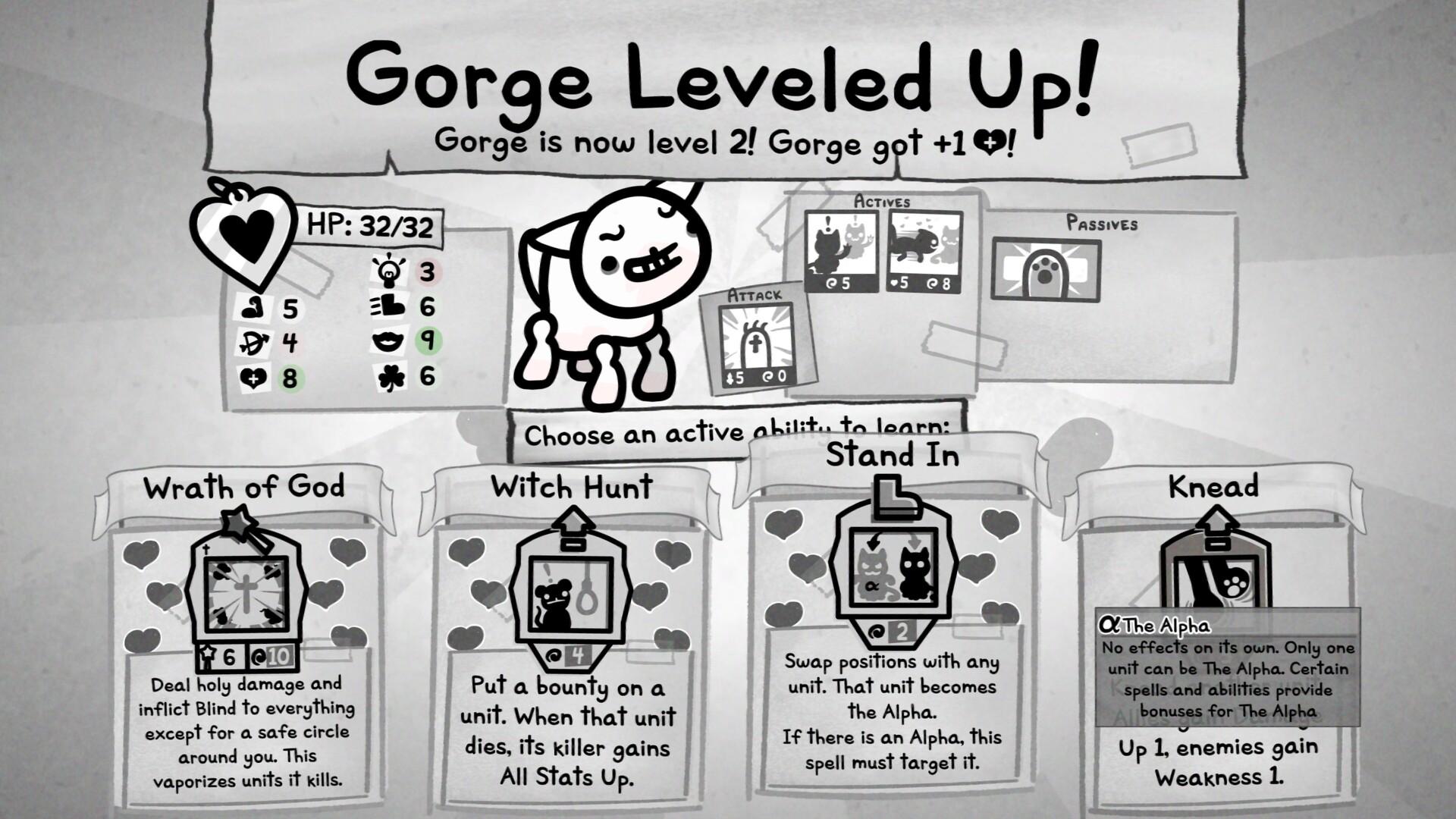

Once in the battles, you’ll control your cats like in almost any other strategy RPG. On each cat’s turn you can move it, use a basic attack, and then use skills depending on how much MP you have. Each time you complete a stage, one of your cats will level up, either gaining a skill or improving its stats. Although character death is always right around the corner, one of the unique features of Mewgenics is that upon losing all their hitpoints your cats don’t immediately die but can be revived at the end of the battle as long as their body remains intact. They will, however, suffer an injury, which will decrease one of their stats. These injuries can sometimes be reversed but often they will be with that cat for the entirety of the run. Injuries can also build up quickly, since your cat won’t be revived to full health upon finishing a stage, so they’re likely to go down again on the next stage if you aren’t mindful. Trying to scrape through a run is important, because if you lose all your cats before you get to an exit point of the adventure (after a boss fight) you lose almost all of the money, food, and items collected, and will have to come back quickly to maintain your food stock.
This requirement to head back out into the adventuring side of the game was sometimes more of a chore than anything else. Each run can take quite a while, so I sometimes felt like the part of the game I most enjoyed was gatekept by a larger, less fun section. Each time you head out on an adventure you must start from scratch, as cats that have already been out and come back aren’t able to go again. Those cats can still breed or defend the house, but the latter is a smaller part of the game that isn’t necessary. As your cats start to level up you can often get interesting combinations of skills that make for incredibly powerful cat crews. One of my favorites was a melee fighter that could destroy all rocks on a stage and gain health for each one, paired with a mage whose skills created rocks. That said, you can sometimes find that you aren’t prepared for the interactions that arise, like when I had a zombie cat army that immediately destroyed my own cats’ bodies whenever they died. Also, when you start an adventure, your cats have minimal skills, so these interactions take a while to manifest.
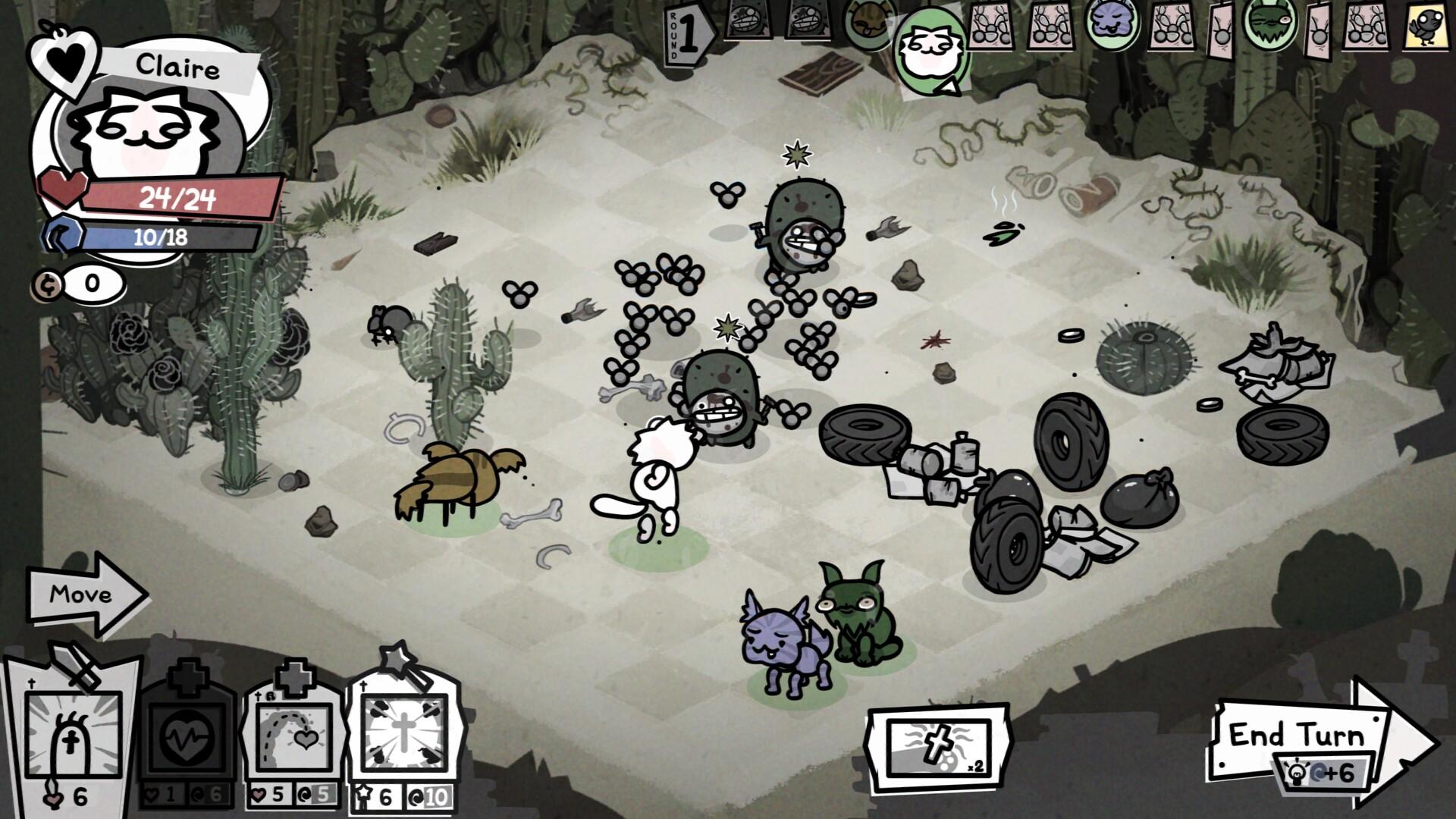
Given the developer pedigree (I’m thinking here of The Binding of Isaac in particular), it should come as no surprise that the visual design is grotesque or sometimes just straight up juvenile, like animated poops. It’s a fun visual style, but the humor isn’t in my wheelhouse. Where the game’s presentation shines is the musical score. There are original songs galore, with lyrics referencing the action on the screen, and they’re often quite catchy. These include boss songs about eating rats, flushing poops, or fighting spiders. One of my favorites was a kaiju-inspired song with Japanese lyrics you hear while fighting a large reptilian cat.
It took me 60 hours to see the credits of Mewgenics and what most people would think of as the end of the game. There was still quite a bit to play after that, though, with a whole new act opening up. I put in another 15 extra hours, but eventually got tired of coming back to adventuring just so that I could continue working on strengthening my cats. Mewgenics is a fun game and definitely worth the 30 dollars I paid at launch, but given how long I’ve happily invested into other RPGs I was a bit disappointed in how tiresome the game loop became for me. That said, playing it felt unique and interesting, and I will be on the watch for what Edmund McMillen & Tyler Glaiel do next.
Full Article – https://www.vgchartz.com/article/467279/mewgenics-pc/


