







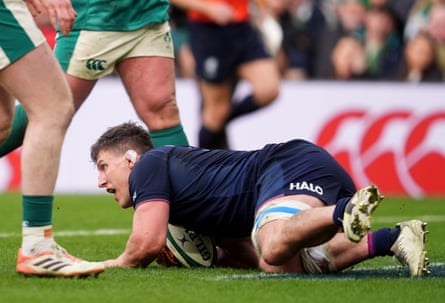
In sporting vernacular Scotland have long looked on Dublin as a “hard place to go”. Roughly an hour’s flight time from Edinburgh, they get to stay in a decent hotel, play in a relatively modern stadium with good facilities, against modestly resourced opponents, and in conditions they could never describe as alien. Despite this comforting familiarity, ever since Dan Parks nailed a touchline penalty at Croke Park in 2010 to scuttle Ireland’s triple crown voyage the Scots have associated this fixture with trying to solve a Rubik’s Cube wearing oven gloves.
On it goes. Faced with the losing run in the fixture hitting a dozen, Scotland did their best to change the narrative. There was no consolation prize in this triple crown decider, but perhaps a sliver of satisfaction at having played a huge part in an enthralling game of rugby where the outcome revealed itself only with 12 minutes left.
By then the benches were already half empty, as were the tanks of those who started and were being asked to go the distance. Caelan Doris, the man of the match, was one of that crew. He namechecked the amazingly consistent Tadhg Beirne afterwards, but could have included a clatter of others, including Robert Baloucoune, who was named as the tournament’s rising star.

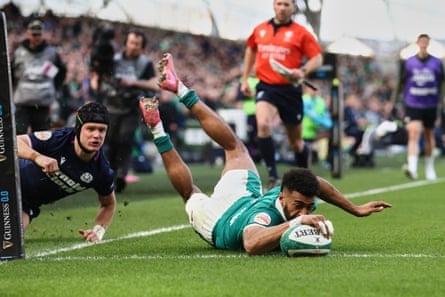
The winger has been around the block a few times. “I’m a bit old to be a rising star at 28,” he said. Along with his fellow Ulster players Stuart McCloskey and Nick Timoney, he was in a category of those well known and under used. That’s changed now.
So has Ireland’s season. From the wreckage of the opening night in Paris, where France beat them all over the park – after which Andy Farrell questioned his players’ intent – Ireland have been transformed. If the win against England was freakishly good against hapless opposition, then this was a savagely good performance against a side who came to play.

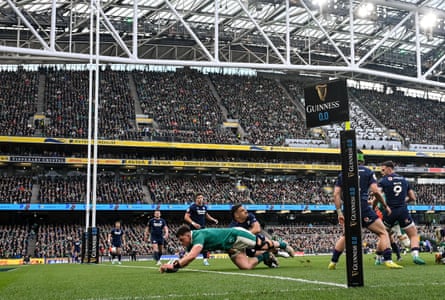
It was good enough to lead after three minutes through Jamie Osborne, and retain the advantage through to a bonus point secured before the hour mark. Only when Tommy O’Brien got over on 68 minutes was there enough daylight for the Ireland camp to breathe easier. O’Brien would get over again as the stewards were in their end-of-match positions: his eighth try in nine Tests. Given his history of injury that’s almost a fairytale stat.
For the tireless Doris, whose captaincy reflects his gravitas in the game, this was one of the best possible days out.
“I think it’s the start of a journey and it’s an important part along the way,” he said. “We still have plenty more building to do but we showed what we’re capable of in this tournament.”
Rarely has he ever been as comfortable at the back of a scrum. With a 100% return out of touch it was the perfect platform for him to lead, yet it was the quality of Ireland’s defence, as much as their efficiency in the Scotland 22, that got them over the line.
After an opening where it looked as if we might be getting a “we score, you score” contest Ireland set about disrupting Scottish rhythm and did a very good job. By half-time their tries from Osborne, Dan Sheehan and Baloucoune had them 19-7 up with Darcy Graham having crossed for the Scots.

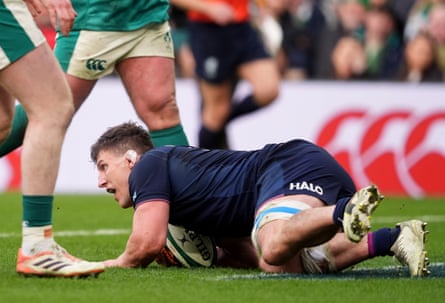
The third quarter was always going to be the decider, but we hadn’t figured on the championship debutant Darragh Murray playing such an important role. He was barely on the field as a blood replacement for Beirne when he scored from close range. Rory Darge hit back for Scotland on 61 minutes to leave just five points in it, at which stage O’Brien slapped on his go-faster stripes and took off for a perfect 10.
There are so many stories wrapped up in this championship, and Ireland’s recovery is only one of them. Sadly for Scotland the numbers game that has haunted them has changed from 11 straight defeats by Ireland to 12.


