






I screamed so loudly when Chloe Kelly scored the winning goal in the 2022 European Championship that our children ran from the room. They were too young to understand what it meant. Since then they’ve watched the Lionesses reach the final of the 2023 World Cup and seen them victorious at Euro 2025. They are growing up with women playing football on TV.
I cried at that win four years ago. I watched the Lionesses in awe, but also with a sense of loss for what I never had the chance to become. According to Fifa’s 2023 Member Association survey report, the number of women and girls playing organised football has grown by 24% since 2019, to more than 16.6 million, with 3.9 million registered female players. Fifa’s Women’s Football Strategy 2024-27 aims to achieve 60 million registered players by next year.
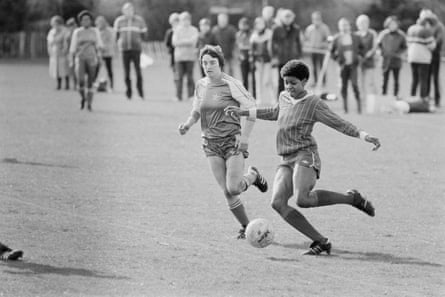
There is a generation of women, however, who have missed out. I’m not talking about the 50-year ban on women playing on FA-affiliated pitches between 1921 and 1971, but on the back of that gaping injustice there were girls who grew up in the 70s, 80s and 90s who loved the game, but had little to no opportunity to play.
Some have turned that experience into a positive. The Crawley Old Girls was founded by Carol Bates in 2015 to offer a club for women from 25 to 80 years old. Bates is “from the generation of women football missed”. In the same spirit, Jo Treharne founded the Canterbury Old Bags for women “who have come to play the beautiful game a little later in life”.
I spent my childhood in the 80s and 90s playing football with a rowdy group of boys on “the green” opposite my house in Birmingham. The goals were silver birches or benches dragged into place. We played every day after school, shoulder-to-shoulder on the ball, calling out, barging for position, knees bruised. We played until the white ball was just a grainy flash across the uneven dusky pitch.

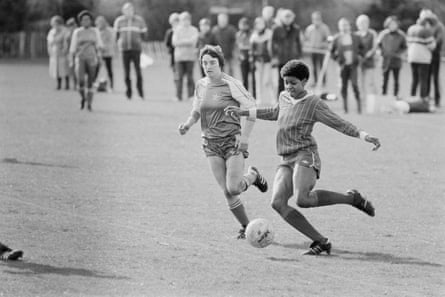
Forty years ago, even playing football with friends was a battle. I was a “tom boy” because girls “couldn’t” play football. At school girls were siphoned off into netball and hockey while boys were primed for football and rugby. There were no local teams for girls and as I grew up I had to prove my worth as a player to the boys in playgrounds, parks and campsites.
By the time I reached my 20s my football scene was reduced to five-a-side tournaments with a team put together on the day or a kick around with friends on summer evenings. Later, with the chaos of family life, the effort of finding a women’s team defeated me and I watched with envy as my kids and husband played on with ease.
Only now, living in Melbourne and nearing 50 years old, have I found my football home. In Victoria, the grassroot scene, surely helped by the popularity of the Matildas, had a 14% growth in 2024-25 for women and girls and recorded 30,928 players in outdoor, five-a-side and social games.
I am now part of this community. I’ve joined a team for women over 35 years old. We play competitively and every week as my three boys wave me off to training I feel the fragile joy of anticipation bubble up inside me.
My teammates were once girls with the desire to play, but with no club to join. One grew up in the 1970s in New Zealand and found her way back to football through coaching girls and finally, in her 50s, joined our team. Another told me she stopped playing when she was 11 and it was 35 years before she played again. She had never played with goals, boots or shin pads. “When I first got in my kit aged 46 I started crying. I felt so empowered.”
Our coach grew up in the UK, wanting to play but never feeling welcome or in the right environment. She lost confidence in her ability until she started coaching. She said: “I’m making up for lost time. I love playing and I love coaching girls in an environment tailored for them.”
As I hear their stories, so reflective of my own, I think of the Three Lions chorus – “thirty years of hurt” – and how it might mean something else for this generation of women who refused to give up on the game they loved. We are finally bringing football home, wherever that is in the world.
Get in touch
If you have any questions or comments about any of our newsletters please email moving.goalposts@theguardian.com.
-
This is an extract from our free email about women’s football, Moving the Goalposts. To get the full edition, visit this page and follow the instructions. Moving the Goalposts is delivered to your inboxes every Tuesday and Thursday.