

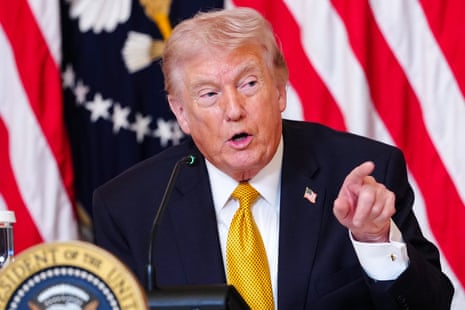
At his press conference Donald Trump also accused Keir Starmer of being overly-dependent on his advisers.
Referring to a decision about Britain deploying a warship to the Gulf, Trump said:
The prime minister of UK, United Kingdom, yesterday told me, I’m meeting with my team to make a determination.
I said you don’t need to meet with your team, you’re the prime minister, you can make your own, why do you have to meet with your team to find out whether or not you’re going to send some minesweepers to help us or to send some boats.
I said you don’t have to meet with your team, it’s the same thing here.
This might be a rare example of Trump saying something that will meet with the approval of at least some Labour MPs. One of the big talking points at Westminster over the past 48 hours has been the publication in the Sunday Times of an extract from the the paperback version of Get In — The Inside Story of Labour Under Starmer by Patrick Maguire and Gabriel Pogrund. Maguire and Pogrund are widely respected for their access and insight into people at the top of the Labour party. The hardback edition of the book depicted Starmer as an opposition leader over-reliant on Morgan McSweeney, but the update is arguably more damaging because it contains numerous quotes from unnamed Labour figures complaining about how passive Starmer has been as PM.
Here is an extract.
[Starmer] only discovered that Sue Gray, his chief of staff, and Louise Haigh, the transport secretary, had given striking train drivers a new pay deal after it had been agreed. The civil servants who had just begun to work with Starmer were baffled at first. Then, as the months ground on, the confounding realisation struck them. Why would Haigh have bothered to consult him? In the frantic meetings after the winter fuel allowance announcement he was a conspicuous, unfelt absence. “We were surrounded by people, who had worked for Blair and Brown,” one adviser said. ‘They would have known exactly what they would have said had they been in a room like that. None of us could say the same about Keir. It wasn’t just that we didn’t know what he would say. We didn’t know whether he would have said anything” …
Cabinet ministers and No 10 advisers strained for loyalty. But it proved too difficult for some. “He is,” said one influential aide upon their departure from Downing Street, “the least intellectually curious person I have ever met.” Said another politician upon whom Starmer relied heavily: “He can only prepare by reading briefing books for hours on end. He doesn’t brainstorm. He has no fixed views on anything. There’s no clarity because there’s no belief. There’s no belief because there’s no understanding. There’s no understanding because there’s no curiosity.”
-
Donald Trump has resumed his war of words with Keir Starmer over Iran, accused the PM of being over-reliant on his advisers and unwilling to take decisions on his own. He was speaking at a press conference in the US where he complained about Starmer not committing to sending ships to help the US reopen the strait of Hormuz. (See 5.43pm.) At his own press conference earlier in the day, Starmer insisted the UK would not be drawn into the wider war in the Middle East. But he did say he wanted to see the strait reopen, and he said that as many countries as possible should be involved in a mission to allow this to happen. (See 11.03am.)
-
Michelle O’Neill, Northern Ireland’s first minister, has described the government’s grant to Northern Ireland to help families hit by rising heating oil bills as a “slap in the face” because it is only worth £17m. (See 12.27pm.) The government is spending £53m across the UK, but almost half the money is going to Northern Ireland because around 50% of homes there use heating oil. In the rest of the UK it is far less common. O’Neill told MLAs at Stormont:
I find the £17m that has been put on the table today to be a real slap in the face, a real slap in the face to families that are struggling, who are already struggling to pay their oil bills.
-
Alex Burghart, the shadow Cabinet Office minister, has accused the government of failing to fully comply with the humble address obliging it to release documents relating to Peter Mandelson being appointed ambassador to the US. In a Commons urgent question, he said:
Since last Wednesday, it’s become increasingly clear that either the government did not follow due process in its appointment of Peter Mandelson or that it is not disclosed all of the relevant documents.
In different terms, either the prime minister’s assurances that full due process was followed were misleading, or the government has not complied with the humble address.
Either would be a contempt of parliament …
There are many, many documents missing. I have detailed 56 to him in a letter that I have sent [to Darren Jones, chief secretary to the PM] to give a few examples.
There is no prime ministerial readout on the advice he received. This is a breach of protocol. A prime ministerial decision, even if made oral orally, should be formally recorded. Where is that record? It starts to stink of the sofa government we had under Tony Blair.
There are no minutes of any meeting at which this appointment was discussed by anyone at any time.
Most suspiciously of all, we have no material from the prime minister, from the chiefs, from his chief of staff or from Peter Mandelson. No box returns, no emails, no forms, no WhatsApp, nothing. It is as though their fingerprints have been forensically removed.
In response, Jones said that some material was being held back because the police were worried it might prejudice a prosecution, and that further documents would be published later. He did not go into detail about why particular documents had been held back, and he would not say why the government had not, in some cases, acknowledged that particularly documents existed without publishing them in full. The Tories repeatedly asked if Mandelson had submitted a full declaration of interests, but Jones sidestepped questions about this.
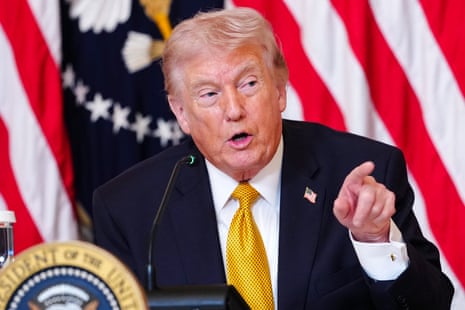
At his press conference Donald Trump also accused Keir Starmer of being overly-dependent on his advisers.
Referring to a decision about Britain deploying a warship to the Gulf, Trump said:
The prime minister of UK, United Kingdom, yesterday told me, I’m meeting with my team to make a determination.
I said you don’t need to meet with your team, you’re the prime minister, you can make your own, why do you have to meet with your team to find out whether or not you’re going to send some minesweepers to help us or to send some boats.
I said you don’t have to meet with your team, it’s the same thing here.
This might be a rare example of Trump saying something that will meet with the approval of at least some Labour MPs. One of the big talking points at Westminster over the past 48 hours has been the publication in the Sunday Times of an extract from the the paperback version of Get In — The Inside Story of Labour Under Starmer by Patrick Maguire and Gabriel Pogrund. Maguire and Pogrund are widely respected for their access and insight into people at the top of the Labour party. The hardback edition of the book depicted Starmer as an opposition leader over-reliant on Morgan McSweeney, but the update is arguably more damaging because it contains numerous quotes from unnamed Labour figures complaining about how passive Starmer has been as PM.
Here is an extract.
[Starmer] only discovered that Sue Gray, his chief of staff, and Louise Haigh, the transport secretary, had given striking train drivers a new pay deal after it had been agreed. The civil servants who had just begun to work with Starmer were baffled at first. Then, as the months ground on, the confounding realisation struck them. Why would Haigh have bothered to consult him? In the frantic meetings after the winter fuel allowance announcement he was a conspicuous, unfelt absence. “We were surrounded by people, who had worked for Blair and Brown,” one adviser said. ‘They would have known exactly what they would have said had they been in a room like that. None of us could say the same about Keir. It wasn’t just that we didn’t know what he would say. We didn’t know whether he would have said anything” …
Cabinet ministers and No 10 advisers strained for loyalty. But it proved too difficult for some. “He is,” said one influential aide upon their departure from Downing Street, “the least intellectually curious person I have ever met.” Said another politician upon whom Starmer relied heavily: “He can only prepare by reading briefing books for hours on end. He doesn’t brainstorm. He has no fixed views on anything. There’s no clarity because there’s no belief. There’s no belief because there’s no understanding. There’s no understanding because there’s no curiosity.”
This is what Donald Trump said at his press conference about being “very surprised” by the lack of support he was getting from the UK over the strait of Hormuz. He said:
I was very surprised with the United Kingdom, because United Kingdom two weeks ago, I said, why don’t you send some ships over? And he really didn’t want to do it.
I said, you don’t want to do it? We’ve been with you. You’re our oldest ally, and we spend a lot of money on, you know, Nato and all of these things to protect you.
We’re protecting them. We’re working with them on Ukraine. Ukraine’s thousands of miles away, separated by a vast ocean. We don’t have to do that, but we did it. Well, Biden did it. I mean, I have to be honest with you, Biden got taken to the cleaners, but we worked with them in Ukraine.
We don’t need to work with them in Ukraine, and then they tell us that we have a mine ship around and they don’t want to do it.
(In fact, France is normally considered the US’s oldest ally because it supported what were then the American colonies in their fight for independence.)
Donald Trump is holding a press conference now. Lucy Campbell is covering it on our US politics live blog.
The Press Association has just snapped this.
US president Donald Trump said he was “not happy” with the UK and “very surprised” over its response to the Iran war.
I will post the full quote shortly.
After Richard Tice’s press conference this morning, Anna Turley, the Labour chair, issued a statement attacking his defence of his decision to take advantage of an unusual (but legal) tax avoidance strategy. (See 1.19pm). She said:
Richard Tice is taking the public for fools. He needs to come clean with the British people as to why he’s gone to such extreme lengths to avoid paying £600,000 in tax.
Tice claimed a particular status for his company for two years and 11 months so that he wouldn’t have to pay corporation tax. The idea that this is the same as having an ISA or making pension contributions is frankly absurd and Tice knows it.
Reform pretend to be on the side of working people, but Tice knows that the extremes he has gone to in order to pay less tax are anything but normal.
In response, Reform UK issued a press notice saying that Labour Party Properties Ltd has received more than £30m in rental income since 2000 but hasn’t paid any corporation tax, according to its accounts. In an open letter, Tice challenged Turley to explain this and whether it was in line with what Labour expects “from the wider business community”.
A Labour spokesperson hit back, saying:
Richard Tice is brazenly attempting to deflect from his own tax affairs by slinging mud and hoping something will stick. He needs to explain to the British people why he has gone to such extreme lengths to avoid paying almost three quarters of a million pounds in tax.
Dan Neidle, the campaigner and tax expert, says it is “not that surprising that a property holding company owned by a political party makes a teensy taxable profit”.
The accounts for Labour Party Properties Ltd are independently verified by auditors and the party is confident its tax liabilities have been accounted for in line with the rules.
Back in the Commons, Brendan O’Hara from the SNP asked a question posed by Zack Polanski, the Green party leader, earlier (see 1.44pm); O’Hara said that US B-52 bombers based at RAF Fairford can carry up to 24 cruise missiles at a time and he asked, given Donald Trump’s comment at the weekend about potentially launching another attack against Kharg Island “just for fun”, what guarantees the UK has had that B-52 missions launched from the UK would not target civilians.
Stephen Doughty, the Foreign Office minister, said he would not comment on “hypotheticals”. But he said that Keir Starmer was “very clear” on what basis he allowed the US to use RAF bases for attacks against Iran. (Starmer said the US could only use these assets for “defensive” missions targeting Iranian missile bases being used to launch attacks against the UK’s allies in the region.)
Karoline Leavitt, Donald Trump’s press secretary, has said that the president “wished the UK had stepped up sooner and quicker” to help reopen the strait of Hormuz.
In his US politics live blog, Shrai Popat says:
Speaking to reporters outside the White House today, press secretary Karoline Leavitt said allied countries “are benefiting greatly” from the US-Israel war on Iran. She added that the Iranian regime’s ballistic missile capability was a direct and imminent threat to our European allies.
“I think the president is absolutely right to call on these countries to do more to help the United States to reopen the strait of Hormuz,” she said.
The press secretary also said that Trump “wished the UK had stepped up sooner and quicker” to help unblock the crucial waterway, following the president’s demands for allies to send warships to the region.
There is more coverage here.
Calum Miller, the Lib Dem foreign affairs spokesperson, told Doughty the government should be tabling a resolution at the UN security council requiring the reopening of the strait of Hormuz.
Doughty said the government was working with international partners to get the strait reopened. He did not address the point about taking this to the UN.
Priti Patel, the shadow foreign secretary, who tabled the UQ, said that Keir Starmer spoke about a plan to reopen the strait at his press conference this morning. She asked Doughty to give details of what that plan was. She said that this was “a hugely consequential moment for the world” and that Britain “cannot stand by and sit on the fence”.
In response, Doughty said plans for the strait were “very complex”. Any mission would have to be multilateral, “with as many nations as possible taking part”. But he could not give details here, he said.
In the Commons Stephen Doughty, the Foreign Office minister, is responding to an urgent question from the Tories about the strait of Hormuz.
He starts by saying Yvette Cooper, the foreign secretary, will make a statement to MPs tomorrow, covering this and other matters relating to the Iran war, including her recent visit to the Gulf. He says she is currently speaking to Marco Rubio, the US secretary of state.
On the strait of Hormuz, Doughty says the Iranian attacks on tankers going through the strait of Hormuz have “put a fifth of the world’s oil supply effectively on hold”.
He says the UK government wants the strait to reopen as quickly as possible. But this is “not a simple task”, he says.
According to the figures in this House of Commons briefing, in 2021 49.5% of households in Northern Ireland used oil for central heating. The equivalent figure for England and Wales was 3.5%.
In Scotland the figure was closer to 5%. Heating oil is not as much as a priority issue there as it is in Northern Ireland (see 2.14pm), but proportionately there are more Scottish families affected by heating oil prices than English families, and opposition parties from Scotland have complained that the sum allocated for Scotland is not enough.
This is from Andrew Bowie, the shadow Scottish secretary.
This support will be welcome for rural households who’ve been ripped off by rogue heating oil suppliers, particularly in Scotland where a higher proportion of homes rely on heating oil.
But in Scotland this money cannot simply disappear into the black hole of the SNP government’s budget. SNP Ministers must guarantee every penny reaches rural households, and the Conservatives will hold them to account to make sure it does.
And this is from the SNP MSP Karen Adam.
Of course support is welcome, but this is a drop in the ocean and after talking it up all weekend, the level of cash delivered here is far from enough from the Labour UK government.
There is a fundamental injustice that people in energy rich Scotland find themselves fuel poor – that a nation with our offshore industry can find its people struggling to afford to fill the oil tank.
(The SNP is an opposition party at Westminster, but not at Holyrood, of course, where it is in government.)
Paul Johnson, the former head of the Institute for Fiscal Studies thinktank who now heads Queen’s College, Oxford, has said that he is worried about the precedent being set by today’s support package for households using heating oil.
In an interview with Times Radio, Johnson said that the amount of money involved in today’s announcement (£53m) was “tiny” in government terms. But he said that it would make it harder for the government to refuse much more expensive bailouts in future. He explained:
The thing that worries me is not so much can [they] find a few tens of millions – as I say a very small amount for this group of people – but what expectations does this set if other forms of power become more expensive?
So if gas prices start to rise, if electricity becomes significantly more expensive, people will say, well you help the people with the oil, but what about the 99% of us, or whatever it is, who don’t use heating oil, who use other forms of energy? Are you going to bail us out?
Now that then becomes staggeringly expensive.
So what worries me is not, is this very expensive? It’s the precedent it might be setting for the future.
