



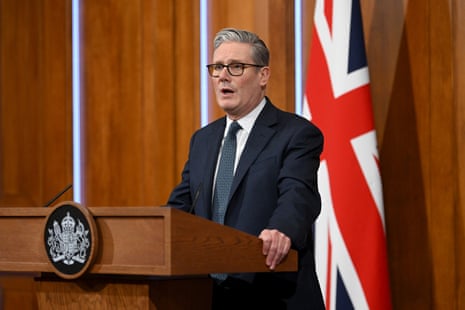
The UK is sending four additional Typhoon jets to Qatar, as well as Wildcat helicopters with anti-drone capabilities being sent to Cyprus, Starmer says.
He says the US has been allowed to use British airfields to carry out defensive missions and that HMS Dragon is heading for the Mediterranean.
More than 4,000 people have arrived back in the UK on commercial flights, he says, with a further seven flights due to arrive in Britain today.
The first charter flight from Oman took off “a few minutes ago”, the prime minister adds.
I want to be very clear; this is a huge undertaking.
It is one of the biggest operations of its kind, many times bigger than the evacuation from Afghanistan.
It’s not going to happen overnight but we will not stop until our people are safe.

-
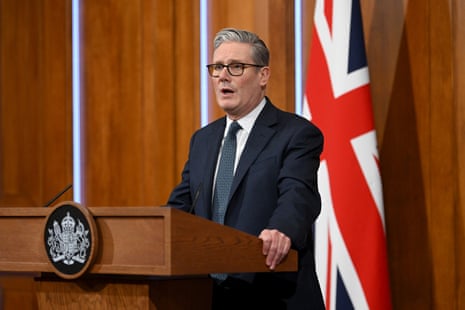
Keir Starmer has insisted the special relationship is “in operation right now” despite not having spoken to Donald Trump since a public fallout over his refusal to allow initial US strikes on Iran from British bases. The prime minister sought to highlight UK-US intelligence-sharing on a “24/7 basis” amid the spiralling Middle East war this week as he faced questions about the American president’s repeated criticism of him.
-
Starmer said that the “long-standing British position is that the best way forward for the regime and the world is a negotiated settlement with Iran where they give up their nuclear ambitions”. He said his decision not to join the US and Israeli offensive strikes was deliberate and that he stands by it.
-
The UK is sending four additional Typhoon jets to Qatar, as well as Wildcat helicopters with anti-drone capabilities being sent to Cyprus, Starmer said in a press conference this afternoon. He said the US has been allowed to use British airfields to carry out defensive missions and that HMS Dragon is heading for the Mediterranean.
-
Cabinet ministers, led by energy secretary Ed Miliband, blocked Keir Starmer from allowing Donald Trump to use British airbases for its attacks on Iran, it has been reported. Chancellor Rachel Reeves, foreign secretary Yvette Cooper and home secretary Shabana Mahmood rallied behind Miliband to oppose the prime minister granting the US permission to use bases in Gloucestershire and the Chagos Islands for bombing runs to the Middle East, according to the Spectator.
-
Kemi Badenoch has said the UK should take offensive action against Iran after UK bases were attacked. “We need to do what we can to stop the ability for these attacks to take place,” the Tory leader told BBC Radio 4’s Today programme.
-
Shabana Mahmood put herself on a collision course with Labour MPs after announcing a set of changes to the immigration system that one backbencher said mimicked Donald Trump and another claimed would lead to a Windrush-style scandal. The home secretary announced her plans on Thursday, including an end to permanent refugee status and the removal of government support from asylum seekers who are deemed not to need it or who break the law.
-
A small number of asylum seekers whose claims are rejected will be offered an “increased incentive payment” of £10,000 per person and up to £40,000 per family to leave Britain under a pilot scheme, Mahmood said. The home secretary said the government would seek to echo reforms introduced in Denmark, where she said there had been “great success” in using incentives.
-
The home secretary said that without “restoring order to our borders,” Labour will allow a populist right-wing government to seize the narrative. She said: “When fearful people turn inwards, their vision of this country narrows and their patriotism turns into something smaller, something darker. And ethnonationalism emerges.”
-
More than 2,000 people had arrived in the UK on Wednesday on eight flights from the United Arab Emirates, MPs have been told by a Foreign Office Minister, Hamish Falconer. A further eight flights are expected from the UAE today.
-
The first government rescue flight from the Middle East failed to take off because of problems “getting passengers on board”, a minister has said. Technical issues meant the flight did not depart on Wednesday night from the Omani capital Muscat.
-
The husband of a Labour MP and two other men have been released on bail after being arrested on suspicion of spying for China. David Taylor, who is married to the Scottish Labour MP Joani Reid, is accused of assisting a foreign intelligence service.
-
Nigel Farage has described May’s Senedd elections as a “referendum” on Keir Starmer, as Reform UK gears up to battle Plaid Cymru for the chance to end a century of Labour dominance in Wales. Launching Reform’s election manifesto in Newport on Thursday alongside the party’s newly appointed Welsh leader, Dan Thomas, Farage said: “It’s a Welsh election, but I’m afraid, whether you like it or not, it doubles up as a referendum on Keir Starmer’s premiership.”
-
Ed Miliband has said he is confident the country’s energy supply is robust despite the conflict in the Middle East disrupting oil and gas shipping lanes. The energy secretary defended the government’s policy not to allow new North Sea exploration licences, and said they would not make any difference to energy bill.
-
MPs are planning to redact the names of 2,000 parliamentary staff from an official register that has been in place for decades, in a move that experts say will reduce transparency around lobbying by passholders. The proposal has been put forward by the House of Commons standards committee after evidence sessions held in private with staff unions, which raised concerns about the safety of those working for MPs.
Reform UK leader Nigel Farage has called out the “hypocrisy” of the Labour party over the arrests of three men, believed to have ties to the Welsh wing of the party, on suspicion of spying for China.
Reform’s former Welsh leader, Nathan Gill, is serving a 10-year prison sentence for taking bribes in return for making pro-Russia statements in the European Parliament.
“It is true that a former senior figure, very briefly in the party, from Reform Wales, did take foreign money and he’s in prison, as he should be,” Farage said.
“But from Labour we have had the moral high ground. We will not hear in this campaign another word of commendation or criticism from the hypocrites in the Welsh Labour Party.”
On Wednesday the Welsh Conservatives called on Eluned Morgan, the first minister, to answer questions in the Senedd on the case. In a short written statement, Morgan said: “Since [this] is a live police investigation, it would be inappropriate for me to comment further on any aspect of this case.”
MPs are planning to redact the names of 2,000 parliamentary staff from an official register that has been in place for decades, in a move that experts say will reduce transparency around lobbying by passholders.
The proposal has been put forward by the House of Commons standards committee after evidence sessions held in private with staff unions, which raised concerns about the safety of those working for MPs.
It would put the Commons out of step with the House of Lords and legislatures in the EU and US, which list most staff members in the interests of transparency.
Under the present system, in place since 1993, about 2,000 staff members working for MPs put their names and any financial interests on a register.
Parliament had decided to widen the register to about 4,000 staff to include those who have access to the parliamentary online network and may be working in constituency offices.
After staff raised safety concerns, the committee recommended redacting the names of all MPs’ staff and replacing them with their job titles, as well as removing from the register anyone who has no financial interests to declare.
As a result, people will no longer be able to see how many individuals are employed by each MP, or their names, and any staff member carrying out work for corporate interests will no longer be identifiable. It will also no longer be possible to see which individual staff members are repeatedly accepting hospitality, for example by going on foreign trips or taking up free tickets.
The UK is sending four additional Typhoon jets to Qatar, while Wildcat helicopters with anti-drone capabilities are being sent to Cyprus, Keir Starmer told a press conference earlier this afternoon.
He also confirmed that the US has been allowed to use British airfields to carry out defensive missions and that HMS Dragon is heading for the Mediterranean.
Nigel Farage has described May’s Senedd elections as a “referendum” on Keir Starmer, as Reform UK gears up to battle Plaid Cymru for the chance to end a century of Labour dominance in Wales.
Launching Reform’s election manifesto in Newport on Thursday alongside the party’s newly appointed Welsh leader, Dan Thomas, Farage said: “It’s a Welsh election, but I’m afraid, whether you like it or not, it doubles up as a referendum on Keir Starmer’s premiership. 7 May will end Labour dominance in Wales and in particular the valleys. And, if we get this right, we will get rid of the worst prime minister any of us have seen in our lifetimes.”
Support for Reform in Wales has surged as Welsh Labour struggles with a 26-year-long incumbency and an unpopular leader in Westminster, although Plaid Cymru are ahead of Reform in most polls.
Farage and Thomas spoke to an audience of approximately 2,000 people at the media conference-cum-rally, where manifestos were available in Welsh and English. About a dozen pro-refugee and pro-Palestine protesters had gathered outside, and shortly after Farage began speaking, security guards removed a heckler from the room.
Thomas listed several areas in which he said Wales was “going in the wrong direction”, including NHS waiting lists, falling education standards and the cost of living.
He said:
This is not inevitable, it is the result of political failure. For more than a century, Labour, propped up by Plaid Cymru in recent years, have dominated Welsh politics … All have failed to deliver what Wales needs.
Ed Miliband has said he is confident the country’s energy supply is robust despite the conflict in the Middle East disrupting oil and gas shipping lanes.
The energy secretary defended the government’s policy not to allow new North Sea exploration licences, and said they would not make any difference to energy bill.
Miliband said more green energy would solidify the country’s energy supplies, meaning the UK is less reliant on other countries.
He also said it would future-proof the UK against economic shocks, as he attributed half of the recessions of the last 50 years to fossil fuel price crises.
It comes as the conflict in Iran has seen shipping in the Strait of Hormuz, which links the Gulf to the Arabian Sea, “significantly” reduce due to attacks.
About a fifth of all global oil and LNG (liquefied natural gas) passes through the strait. Speaking in the House of Commons, Miliband told MPs:
I’ve been in touch with National Gas and Neso (National Energy System Operator), who are confident about our security of supply [of gas].
On oil, we hold substantial emergency commercial stocks and stand ready to work with the International Energy Agency to support the stability of oil markets if needed.
He said the government had continued to learn lessons from the Russian invasion of Ukraine, which led to energy prices surging due to the boycott and disruption to Russian gas pipelines.
In what could become another row that pleases almost no one, Labour has moved forward on its pre-election promise to define ‘Islamophobia’.
The government has watered down its previous definition by removing all references to “racialisation”, according to the Sun. That’s against the advice of cross-bench peer Shaista Gohir, who’s on the working committee advising the government on the new definition.
She’s previously said that Muslims are previously targeted based on their appearance, not just their religion. “Including the element of racialisation validates these lived experiences,” she said.
The report also notes that the government has backed down to critics and will define “anti-Muslim hatred” rather than “Islamophobia”, something that is likely to anger Muslim groups. That aligns with reporting from my colleagues that revealed that the working group put forward a proposal that defined anti-Muslim hostility.
But in a sign that the government is hoping to avoid too much controversy, Starmer himself referred to both “anti-Muslim hatred” and also “Islamophobia” at an iftar event on Tuesday night organised by the all-party parliamentary group (APPG) for British Muslims.
A reminder too that the definition won’t be statutory or legally binding but activists have argued it’s necessary to give guidance to groups such as police, businesses and community groups to recognise anti-Muslims hostility – and give people confidence to report discrimination.
Shabana Mahmood has put herself on a collision course with Labour MPs after announcing a set of changes to the immigration system that one backbencher said mimicked Donald Trump and another claimed would lead to a Windrush-style scandal.
The home secretary announced her plans on Thursday, including an end to permanent refugee status and the removal of government support from asylum seekers who are deemed not to need it or who break the law.
She also launched a pilot project to pay 150 families whose asylum claims have been rejected up to £40,000 each to voluntarily leave the country, or face forcible removal at the hands of law enforcement officials. Those families have been contacted and have seven days to decide whether to accept or refuse the offer.
The plans triggered an immediate backlash from Labour MPs, who said they were unfair and risked further alienating core Labour support after last week’s damaging byelection loss to the Greens.
Tony Vaughan, the Labour MP for Folkestone and Hythe, organised a letter that he said had been signed by 100 of his party colleagues, saying that the proposals undermined the government’s commitment to integration and social cohesion.
He said:
We can change our immigration system for the better without forgetting who we are as a Labour party.
You don’t win back public confidence in the asylum system by threatening to forcibly remove refugees who have lived here lawfully for 15 or 20 years. That just breeds insecurity and fractured communities.
His sentiments were echoed by Stella Creasy, the MP for Walthamstow, who said:
There’s no ‘fairness’ in repeatedly spending money on asking victims of trafficking and civil war if they are still in that category – especially when we have already given them refugee status so confirmed they are at risk of harm.
Ukrainians, Iranians [and] Afghans alike will all now live in a perpetual state of limbo, not able to plan any kind of life either here or in their home nation because they can’t guarantee their status, making them easier to exploit too. I look forward to reading the NAO [National Audit Office] report and the inevitable Windrush-style scandal coming that none of us stood on a manifesto to implement.
The Guardian’s Pippa Crerar asks if Starmer has been afforded any insight by president Trump in relation to how long the war could last
He says:
Clearly, that is a concern for everybody. Thats why we’ve been absolutely clear that we need to de-escalate.
He adds that he has had discussions with Trump about the operation, while conversations are ongoing across all levels.
The prime minister is asked if he had spoken to Trump since his criticism of him, to which he says he last spoke to him on Saturday evening.
That is the end of the press conference.
Asked to comment on Donald Trump’s words that he has “ruined the special relationship”, Starmer says that relationship is in operation right now.
He says he has to take decisions as the British prime minister that are in the best interests for the UK.
He adds:
Look, the special relationship is in operation right now.
We’re working with the Americans in the deployment from our bases. We are working together in the region, the US and the British, working together to protect both the US and the British in joint bases where we’re jointly located, and we’re sharing intelligence on 24/7 basis in the usual way.
That is the special relationship. That is a special relationship in operation, and clearly, it’s for the president to take decisions that he considers in the national interest the right decisions for the US.
I understand that, I respect that, but equally, it’s for me as the British prime minister to take decisions that I consider to be in the best interest of the United Kingdom.
There’s nothing controversial about that. The special relationship is operating right here at an important point.
Starmer is asked outright whether the reports were true that he wanted to give the US permission to use UK airfields last week but was blocked by cabinet minister, led by Ed Miliband (see post 9.38am).
He says:
Let me be really clear about this; no request came in the specific terms that we acceded until Saturday afternoon.
He adds that there was no request from the US on Friday and therefore there was no decision to be made. He says the final decision was unanimous among his cabinet.
ITV’s Robert Peston is asking whether Starmer’s “initial decision” not to join the US and Israel in launching offensive strikes on Iran could be reviewed further down the line.
Starmer says “we are working with our allies and the US on this” and that the pre-deployment was carried out in conjunction with the US.
He does not address the point about reviewing the decision in the future.
Beth Rigby, from Sky News, asks if he will apologise to British military personnel in Cyprus who were left unprotected.
The prime minister says:
Our absolute priority is the safety of our citizens and that is the focus for all the decisions I have taken.
Keir Starmer is defending himself accusations of dithering in response to the crisis by saying the UK began pre-deploying assets to the region from January.
He tells Chris Mason, from BBC News:
There’s been a lot of pre-planning that’s gone into this, there’s been a lot of pre-deployment that’s gone into this.
I’m satisfied that we can keep our people safe.
The prime minister says that while others seek to use the conflict “to divide us”, Britain should be coming together in this moment.
Starmer says:
As a nation, we should come together in this moment. Those citizens that are stuck in the region, scared and in need of help, come from all backgrounds.
The armed forces who protect them come from all backgrounds too. We are united by our common humanity and our love of this country.
He warns that the conflict could carry on for some time and says the UK government is “resolute in its response at home and abroad”.
The UK is sending four additional Typhoon jets to Qatar, as well as Wildcat helicopters with anti-drone capabilities being sent to Cyprus, Starmer says.
He says the US has been allowed to use British airfields to carry out defensive missions and that HMS Dragon is heading for the Mediterranean.
More than 4,000 people have arrived back in the UK on commercial flights, he says, with a further seven flights due to arrive in Britain today.
The first charter flight from Oman took off “a few minutes ago”, the prime minister adds.
I want to be very clear; this is a huge undertaking.
It is one of the biggest operations of its kind, many times bigger than the evacuation from Afghanistan.
It’s not going to happen overnight but we will not stop until our people are safe.
Keir Starmer has said that the “long-standing British position is that the best way forward for the regime and the world is a negotiated settlement with Iran where they give up their nuclear ambitions”.
He says his decision not to join the US and Israeli strikes was deliberate and that he stands by it.
He says:
While the region has been plunged into chaos, my focus has been on providing calm, level-headed leadership in the national interest.
It means having the strength to stand firm by our values and by our principles, no matter the pressure to do otherwise.
However, he says, once Iran started retaliating the situation changed. “Our number one priority is protecting our people,” he says, in reference to the thousands of Britons living in the Middle East.
He says throughout January and February, the UK moved military assets to Cyprus and Qatar “to ensure we were in heightened state of readiness” in case of conflict.
Meanwhile, Kemi Badenoch’s description of Keir Starmer’s MPs as clueless “orcs and goons” and other language used by her frontbench team amid the ongoing Middle East crisis have sparked an angry response from a former diplomat turned Foreign Office minister as he updated MPs on evacuation flights from the region.
There were angry clashes between Hamish Falconer and the shadow foreign secretary, Priti Patel, as she demanded to know why the foreign secretary, Yvette Cooper, had not come to parliament and accused her of not providing leadership.
“I will not reflect on my own time as an official during previous crises where the same was not said about foreign ministers during such times,” said Falconer, who was a civil servant during Conservative-led governments and has experience of running evacuations during similar crises.
The foreign secretary, Yvette Cooper, had been in her department’s crisis centre since Saturday, said Falconer, who singled out comments by Badenoch this week when accused the prime minister of being advised “sea of orcs and goons who have no idea how anything is working at all.” The Conservative leader has said it was a reference to the characters of JR Tolkein and told the BBC’s Today programme that had to respond when Labour MPs tried to use her “as a punchbag.”
However, the exchanges in parliament on Thursday again struck a bitter tone as as the chair of the Foreign Affairs committee, Emily Thornberry, accused the opposition of failing in their “responsibility to always put the country first and not play narrow party politics.” “As for throwing personal abuse across the dispatch box at time like this I am profoundly shocked,” she added.
Another Labour MP, John Slinger, accused Badenoch’s team of undermining national security by using language in an attempt to “wrap themselves in the cloak of national security and patriotism.”
More than 2,000 people had arrived in the UK on Wednesday on eight flights from the United Arab Emirates, MPs have been told by a Foreign Office Minister, Hamish Falconer. A further eight flights are expected from the UAE today.
British Airways has also now agreed to lay on new flights from Muscat, the capital of Oman, which were expected to fly every day after talks with the government, he added.
However, there was criticism from MPs including shadow foreign secretary Priti Patel, who pressed the government on the failure of the first repatriation flight chartered by the UK government to take off via Oman on Wednesday evening.
The British prime minister will give a press conference at 2pm on the US-Israeli war on Iran and the escalating conflict that’s engulfing more countries in the region.
In a post on X, he said:
I know that the situation in the Middle East is worrying for people across the UK and in the region.
This afternoon, I’ll be giving an update on the action we continue to take to protect lives and bring British nationals back home.
Starmer has come under criticism from Donald Trump this week after the government initially refused to allow the US to use British airbases for “defensive” attacks (which he refers to as striking down Iran’s military capability in the country).
The country has resolved to send a destroyer, HMS Dragon, to Cyprus to help protect the country after a drone evaded detection and hit an RAF base there although it isn’t expected to arrive until next week, Britain will also send two Wildcat helicopters with counter-drone capabilities.
Governments around the world have worked on evacuating their citizens out from the region but Britain has faced some issues with this. A flight was expected to depart Oman last night but failed to leave because of a problem “getting passengers on board”, a minister has said. Others have since arrived.
A total of 138,000 people from the UK have registered for assistance, the government said. 112,000 of those are in the UAE.