







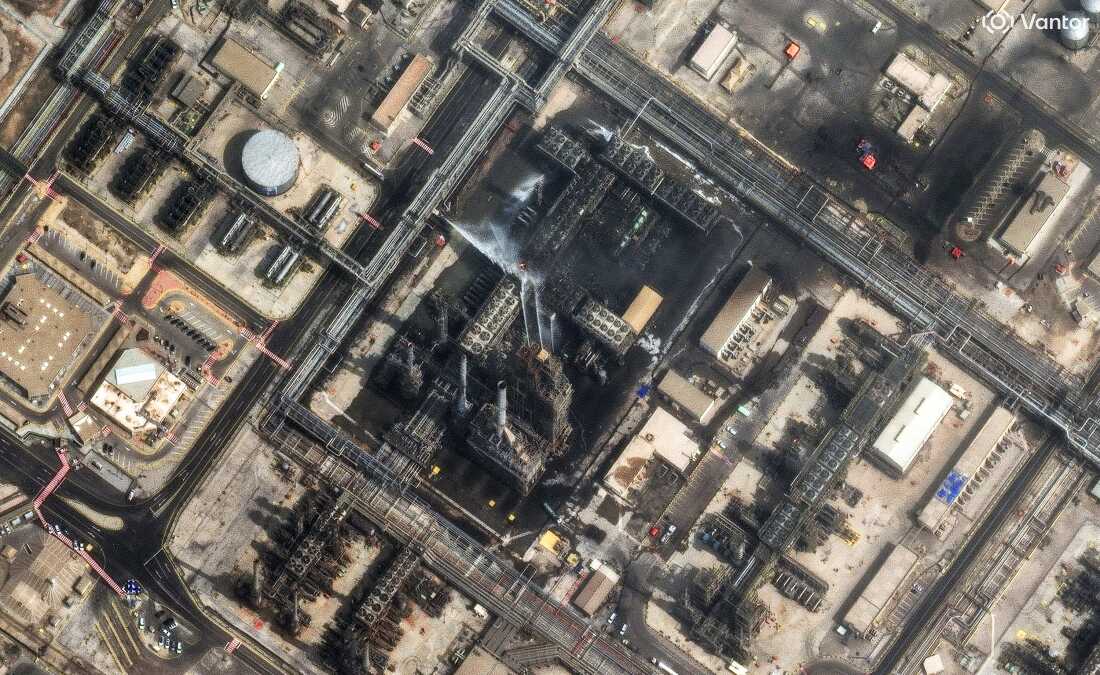
Vantor satellite image shows firefighting efforts and damage assessment at Ras Tanura oil refinery in Saudi Arabia following a fire incident in early March 2026. Maxar/Satellite image (c) 2026 Vantor via Getty
Maxar/Satellite image (c) 2026 Vantor via Getty
New drone strikes hit a major oil refinery in Bahrain on Thursday. The missile strikes were fired by Iran, according to the Bahrain News Agency.
Recent conflicts in the Middle East have either spared energy infrastructure or limited damage to a particular country. That isn’t the case in the current war with Iran.
In less than a week, strikes have hit energy infrastructure in at least six countries. Refineries in Bahrain, Kuwait, Qatar, Saudi Arabia and the United Arab Emirates have been hit, those countries have reported. Qatar’s liquified natural gas export facility, Ras Laffan – the biggest in the world – has also been struck.
While many countries have pointed the finger at Iran for the strikes on energy facilities, Iran has accused Israel of hitting a refinery in Saudi Arabia.
“ I do not think there’s precedent for this kind of regionwide conflict with facilities coming under attack from all kinds of methods, over a wide era, and all types of facilities at basically the same time,” says Robin Mills, chief executive of Qamar Energy, an energy advisory company based in Dubai.
Sponsor Message
Loading…
About a fifth of global liquified natural gas, or LNG, comes from Qatar. LNG is natural gas that’s cooled to about -260 Fahrenheit and then transported around the world on ships. It’s used for electricity, heating, and making petrochemicals like plastics.
State-owned QatarEnergy shut down production following the strikes on the Ras Laffan LNG facility. And, like most energy companies in the Persian Gulf, the company cannot move cargoes through the Strait of Hormuz. On Wednesday, QatarEnergy declared force majeure, a legal term relieving the company from contractual obligations. It’s likely that buyers in Asia and Europe won’t be getting that Qatari LNG for weeks if not longer, says Antoine Halff, chief analyst at Kayrros, a climate and environmental analytics firm. Israel has also shut down some offshore natural gas production.
The world is currently oversupplied with oil, but that’s not true of natural gas and LNG, says Gerry Kepes, president of Competitive Energy Strategies, an energy consultancy in Washington D.C. It’s the end of the winter in the Northern Hemisphere and natural gas storage levels are low in Europe.
“This may be the first time in history that the shutdown of LNG from the Gulf will have a more pervasive and negative impact than a cessation of crude oil exports,” Kepes says.
“The consequences of the war for gas and LNG are uncertain but could rival those that followed Russia’s invasion of Ukraine in 2022,” Simon Flowers, chairman and chief analyst at research firm Wood Mackenzie, wrote in a press note on Thursday.
Natural gas prices in Europe have risen more than 60% since the war began. Natural gas prices in Asia have risen more than 40%.
LNG producers in countries like Australia and Malaysia could potentially reroute some LNG cargoes to buyers in Asia and Europe.
The U.S. has become the largest LNG exporter in the world, with new facilities set to open in the Gulf Coast this year and next. Still, Mills says there’s not a lot these LNG companies can do to quickly make up for the lost supplies from the Persian Gulf.
“Countries and companies don’t really carry LNG spare capacity,” Mills says. “They run the plants as close to full out as they can almost all the time.”
Several LNG producers outside the Middle East region are already seeing stock prices increase. Australian LNG producers Woodside Energy Group and Santos Energy have seen their stock prices rise more than 9% and more than 10%, respectively, in the last week since the war began.
In the U.S., LNG producers Cheniere and Venture Global have seen their stock prices rise more than 8% and more than 27%, respectively, in the last week.


