





Dragon Quest fans have been living well as of late. In 2024, they enjoyed an HD-2D remake of one of the most beloved titles in the entire canon, Dragon Quest III. One year later, in 2025, they closed out the Erdrick trilogy in style with Dragon Quest I & II HD-2D Remake. And just last month, they were offered the opportunity to piece together fragments of the forgotten past in Dragon Quest VII Reimagined, which overhauls the classic turn-based RPG from 2000. Based on screenshots and video alone, it’s clear that Reimagined is technologically superior to the PlayStation best-seller. But is it the definitive version of the game?
Some small adjustments notwithstanding, Reimagined follows the same plot beats as the original game. It starts in a sleepy fishing village on the small island of Estard, the only known island in the entire world. It’s here where the young protagonist (let’s call him Hero) and his best friend Prince Kiefer obtain a mysterious stone fragment with a piece of a map. Hero and Kiefer, having long dreamed of leaving the island and looking for other civilizations, realize this stone fragment could be the key to their much-anticipated grand adventure. Along with Maribel, the daughter of the village’s mayor, the dynamic duo discover a way to use the map piece to unlock a portal into the past. Soon enough, they discover many more portals, each leading to a different island that is trapped in the past and facing some crisis that only the heroic party can overcome.
The story is the best, most important part of Reimagined, just as it was in the PlayStation and 3DS versions of Dragon Quest VII. Because of its fragmented structure, in which the emergencies of individual towns and islands are more urgent than the dangers in the larger world, the game has the freedom to explore smaller, more intimate stories with diverse, discrete themes and motifs. And these stories hit hard. From the very beginning, when Hero, Kiefer, and Maribel visit a village haunted by the cowardice of its past and the blood on its hands, the game refuses to compromise on the heaviness and darkness of its narrative. The campaign has plenty of heroes and villains, sure (this is an RPG after all) but also many gray characters who occupy a morally nebulous area. And for every happy, redemptive ending, there is a bittersweet, tear-jerking denouement.
The main characters are quite interesting as well. Hero, as the blank slate protagonist, is the least exciting, but Kiefer, Maribel, and latecomers Ruff, Mervyn, and Aishe really grow on you. Kiefer’s character development, in particular, is a beautiful thing.
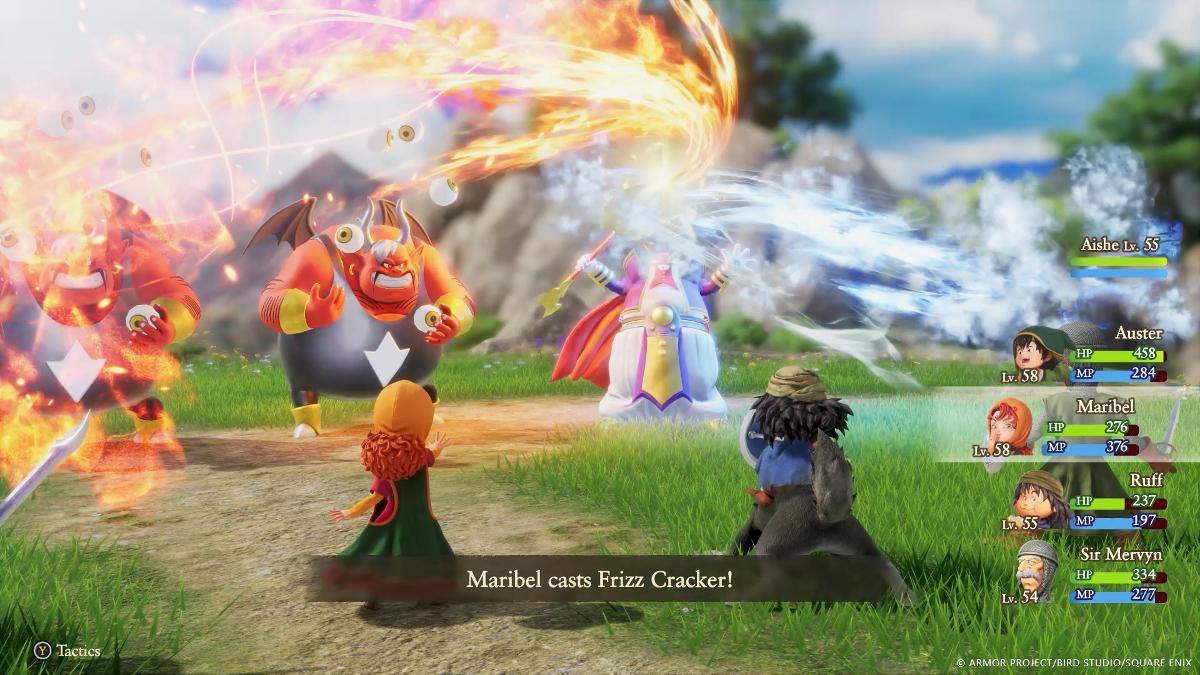

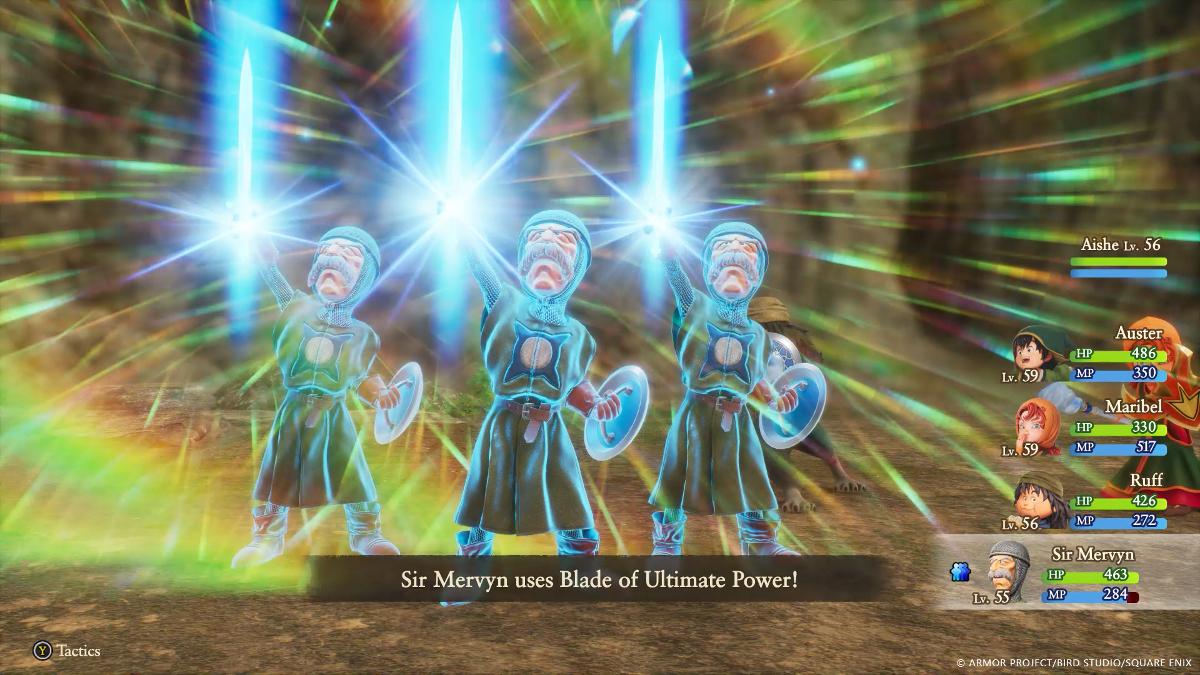
You’ll control some combination of these characters throughout your adventure, as you travel back and forth through time and face all manner of monsters in turn-based combat. The basic rules and rhythm of combat remain the same in this remake, albeit with some notable enhancements. For starters, you can now adjust the speed of battle or even automate your character’s turns. What’s more, you can leverage each character’s vocation in a new way, via Let Loose. If a character absorbs a lot of damage, or satisfies some other prerequisite, they’ll become “worked up”, enabling them to “let loose” on their turn, which activates a unique perk. For example, if Ruff is classed as a Warrior, he can trigger Art of Chivalry, which provides cover for the ally with the lowest HP and then delivers a counterattack.
Let Loose is a great addition, in part because the combat framework in Reimagined isn’t all that complex. It’s a very classical setup with spells, buffs, debuffs, attacks, and defensive posturing, but not a lot in the way of tactical wrinkles or character synergies.
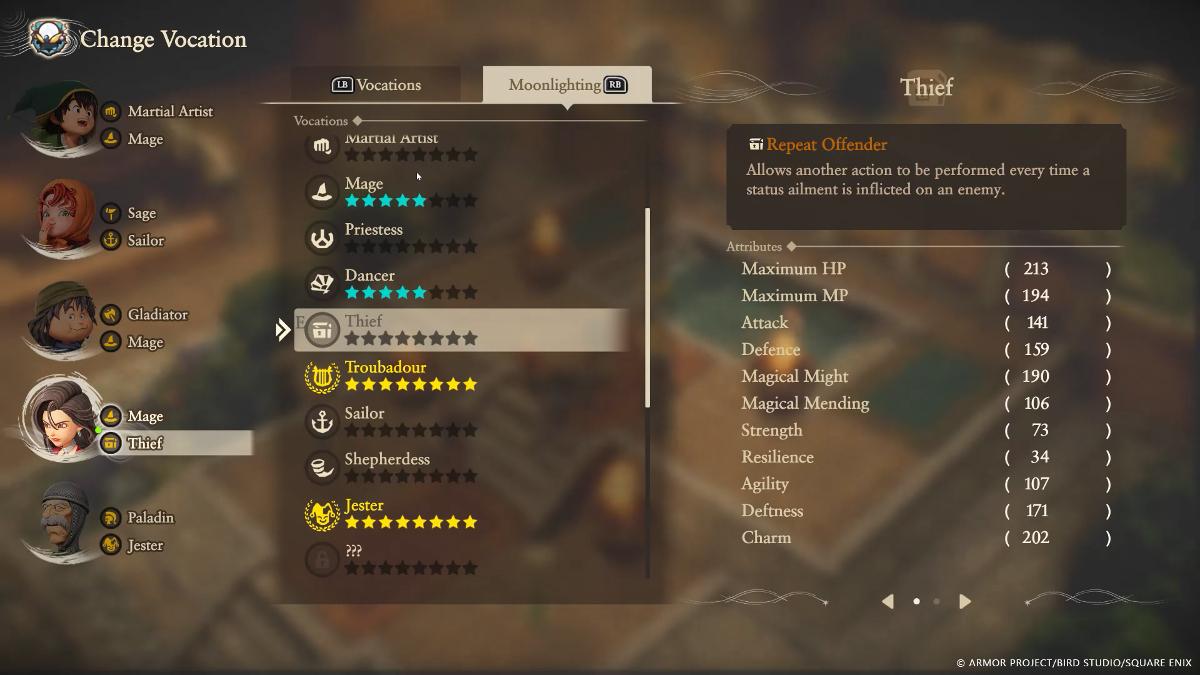
That’s not to say Reimagined is without tactical decision-making. It just happens, primarily, in the lead up to battle, during the process of mixing and matching vocations. This is where the remake is most engaging, at least in terms of mechanics. From the start, each hero is assigned a default vocation, or job. Kiefer, for example, is an Heir Apparent, skilled in weapons-based elemental attacks. About 18-20 hours into the game, the party gains the ability to swap to a different vocation, which alters their baseline stats (HP, MP, attack, defense, agility, etc.) and opens up a new slate of spells and/or abilities. As you clear combat encounters, each vocation will level up in parallel to the character, slowly unlocking more skills. And when you finally master one or more vocations, you’ll gain access to intermediate and advanced vocations, which boast bigger attribute boosts and more powerful spells and abilities. It’s great fun to gradually obtain more and more spells until you finally hit that mastery level.
And the process is even better now, thanks to the remake. In the original game, you had to travel to Alltrades Abbey every time you wanted to swap vocations. In Reimagined, you can do so anywhere on the map once you obtain the cleverly named Career Sphere. Not only that, but after you recruit a particular character, you’ll unlock the Moonlighting feature, which allows each hero to use two vocations simultaneously, opening up many more strategic possibilities.
Career Sphere and Moonlighting are emblematic of a larger push in Reimagined to streamline the campaign and reduce backtracking. And for the most part, this push is successful. In the original version, for example, it took almost three hours to get to the first battle; in Reimagined, it takes no more than an hour. Additionally, you’ll fight in fewer battles, since you can avoid roaming enemies or even dispatch them from the overworld without entering the battle phase, as long as they’re significantly underpowered relative to the party.
But the game is a bit overeager when it comes to scaling back content. Three islands from the original have been removed altogether, and several others have been made optional. The missing islands aren’t essential from a narrative point of view, which explains why they didn’t make the cut, but they did offer something of value. This is especially true of Immigrant Town (aka the Haven), which allowed players to recruit and re-home NPCs from various towns. The casino is another casualty, although thankfully the Lucky Panel mini-game exists elsewhere in the game.

Because of the new quality-of-life elements, the removal of several islands, and the general streamlining of the narrative, Reimagined is notably shorter than the original, although still quite long compared to most games. Where you would need ~100 hours to make a serious dent in Dragon Quest VII on PlayStation, you’d need only 60 hours to achieve the same amount of progress in the remake.
While the original game remains the king in terms of content, it can’t compete with Reimagined when it comes to visuals. Even for its time, the PS1 game was somewhat meek graphically. The remake, conversely, is absolutely gorgeous, thanks to a striking diorama art style. Everything is detailed, vibrant, and whimsical. The team at Square Enix even went the extra mile to craft real-life dolls for each of the main characters and then scan them into the game. It really does justice to Akira Toriyama’s iconic designs, even if Kiefer looks a bit like a Thunderbirds puppet.

Reimagined also tops previous versions of Dragon Quest VII on the audio side of things. This is the first iteration of the game to feature full voice acting, and it makes a difference. The characters are more colorful and enchanting, particularly the sassy and imperious Maribel, brought to life by Becky Wright. Then there’s the music, originally composed by Koichi Sugiyama and enhanced in this remake thanks to a brand new orchestral recording. It’s never sounded fuller or richer.
Dragon Quest VII Reimagined is a great remake, in the end. It retains the core components of the PlayStation title — an emotionally powerful narrative, a diverse set of role-playing scenarios, and a tactically rewarding vocation system — and enhances them with gorgeous visuals, immersive voice-acting, several important quality-of-life features, and superior pacing. Is it the definitive version of the game, though? No, not exactly. In a noble attempt to streamline the experience, Square Enix has cut or sidelined too much content from the original. As a result, Dragon Quest VII fans should keep both in rotation.
Full Article – https://www.vgchartz.com/article/466917/dragon-quest-vii-reimagined-ps5/