

For the past 15 years, Mario Tennis games, and Mario sports titles in general, have failed to leave a strong impression. They’ve occupied that competent range between decent and good, but failed to achieve the high marks set on N64, GCN, and GBA. Looking to reverse that trend is Mario Tennis Fever, the newest sports game from Camelot, which has shepherded the series since 2000. The inclusion of Fever Rackets, each of which adds some elemental effect or hazard to the action, suggests that this latest installment has more than a few tricks up its sleeve. Is it enough, though, to pull Mario Tennis upward into that next tier of greatness?
Fever offers several different modes, but you should probably start with Adventure Mode. Not because it’s great, but because it will familiarize you with the rules and expectations of the game — sometimes, unfortunately, at a glacial pace.
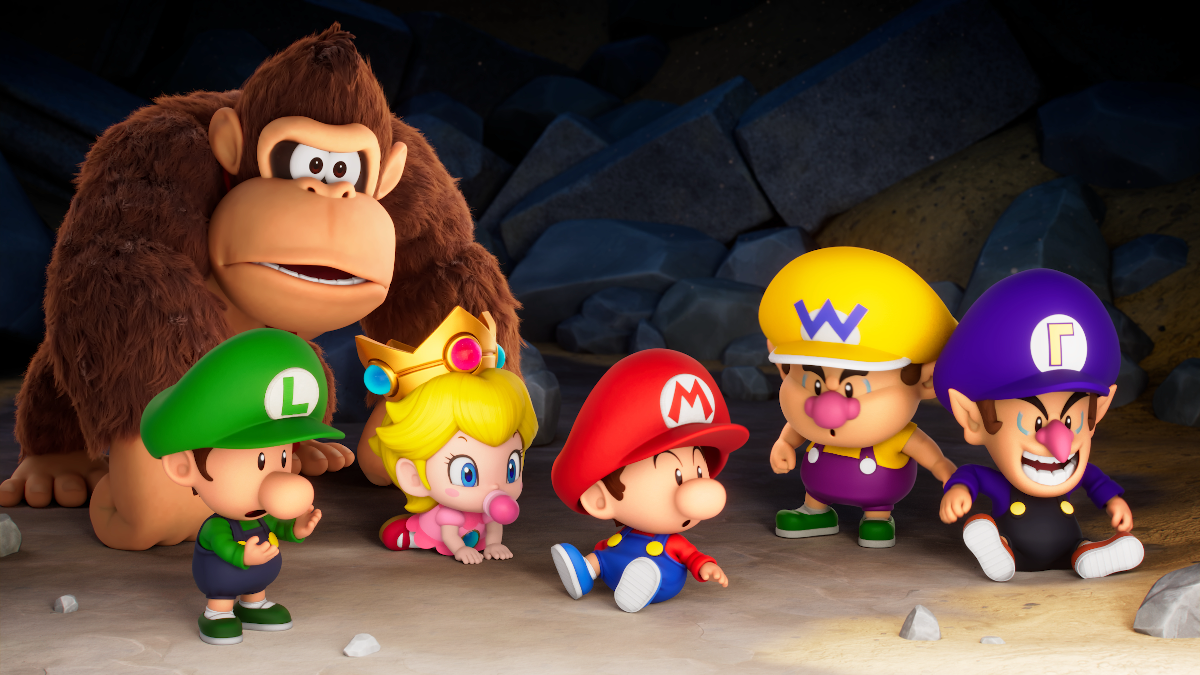
The story in Adventure Mode is bonkers, even by video game standards. Ahead of the Mushroom Kingdom Tennis Tournament, Princess Daisy becomes bedridden with some serious illness. In their desperation, her friends — Mario, Luigi, Peach, Toad, and Donkey Kong — turn to perennial ne’er-do-wells Wario and Waluigi, who suggest that a magic golden fruit in a far-off land can save her. When they arrive at the destination, the gruesome twosome suddenly and inevitably betray Mario and company, in the process provoking shadowy monsters that turn Mario, Luigi, Peach, Wario, and Waluigi into baby versions of themselves. After returning to the Mushroom Kingdom, Mario and Luigi are enrolled in the Mushroom Tennis Academy, because, as Toad says, “well, if they’d had real rackets before, they could have volleyed back the attack.”
Despite this amazingly preposterous premise, Adventure Mode fails to impress. For starters, it’s less than four hours long, and could be beaten in an afternoon. For another, it spends almost two of those hours spinning its wheels at the Tennis Academy, where Mario and Luigi undergo painfully slow, rudimentary lessons on tennis. Now, for neophytes, this sort of elementary education is helpful, but it could still be delivered in more exciting ways. As it stands, Mario participates in a monotonous mini-game with some dubious connection to a tennis shot or mechanic, then receives a lesson from Toad, then deploys the lesson in a live match, and then repeats the process. Sometimes, he has to participate in a multiple-choice quiz from a tennis instructor. It’s all very basic and tedious. This mode would benefit greatly from some role-playing or simulation elements. It’s a tennis academy, after all; it’s the perfect place for rivalries, alliances, extracurricular activities, etc.
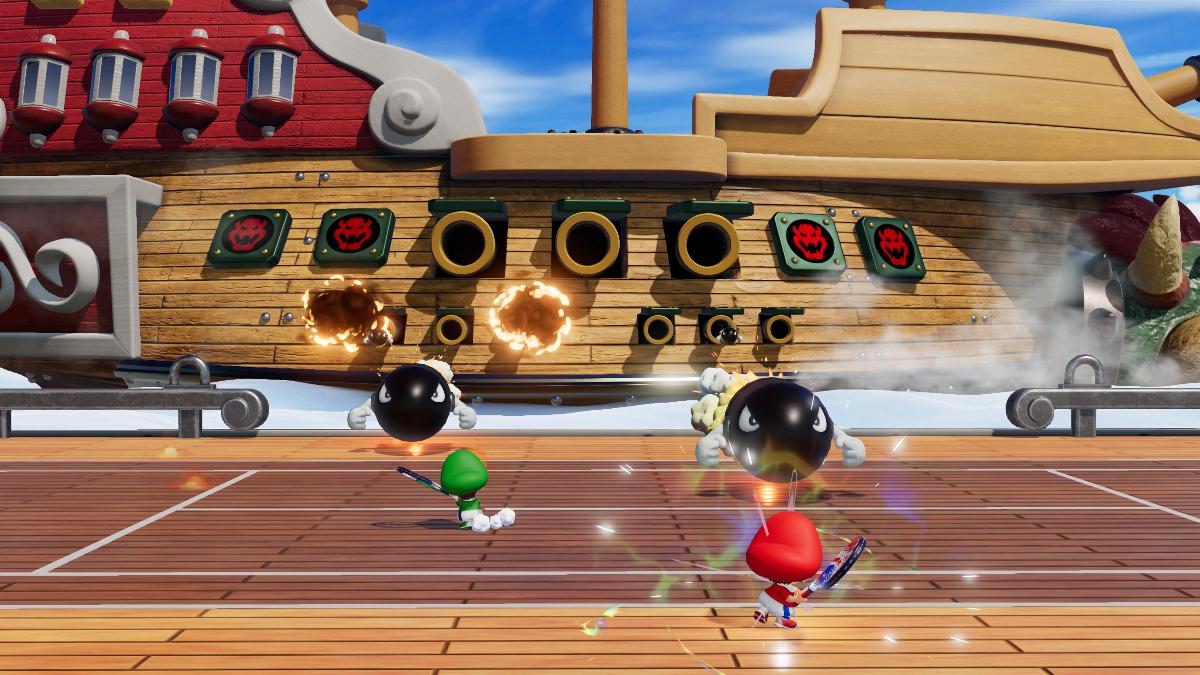
Adventure Mode does get significantly better once it leaves the Academy, but this piece lasts only two hours, give or take. This section is more “adventure” and less “tutorial”, and focuses on the long, difficult trek back to the site of the original transformation. It features a fair amount of exploring and several inventive boss battles. One specific battle, in which the team fends off Hisstocrats aboard a makeshift barge, is particularly memorable. But just as things are getting good, the adventure ends.
Fortunately, there are other, superior ways to enjoy Fever outside of its single-player campaign. The best is the simplest: Free Play. This is an open-ended versus mode where you can play in singles and doubles matches to your heart’s content. It’s also the easiest place to experiment with the game’s very generous collection of characters and Fever Rackets. There are a whopping 38 characters, each with their own stats and special skills, plus 30 unique rackets imbued with some elemental or shot-altering ability. As a result, there are hundreds of combinations.
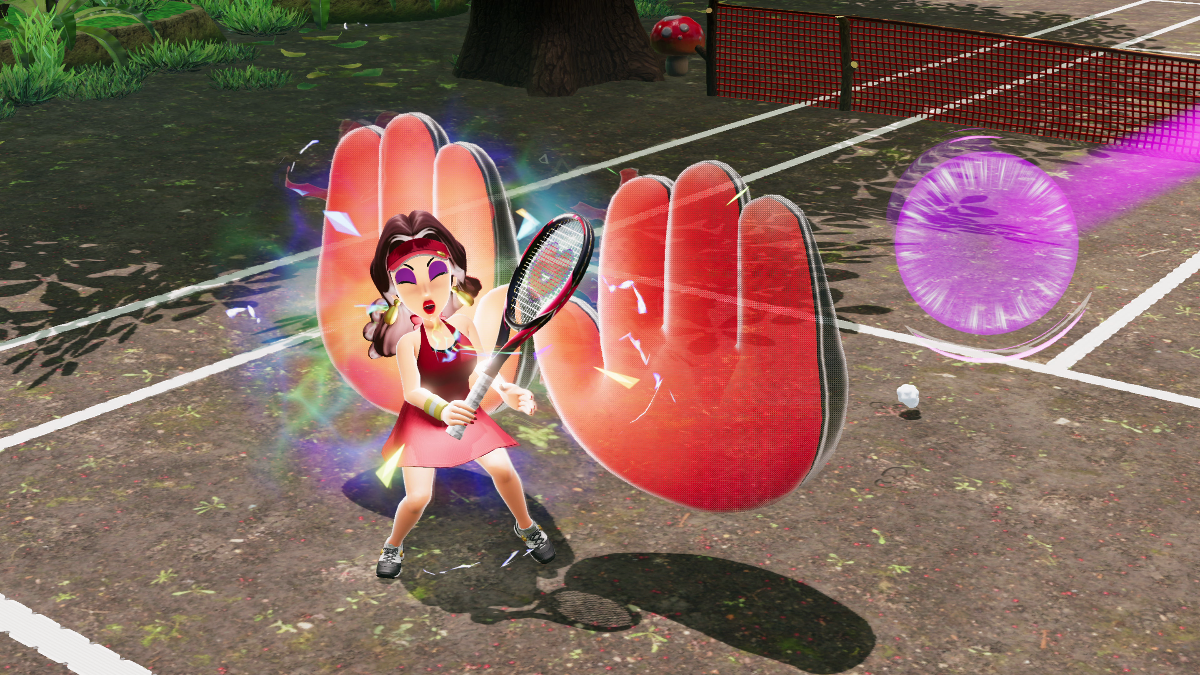
What’s more, the combinations are meaningful. Each character attacks, defends, and moves in different ways, and each racket plays to a certain mindset. The Flame Racket leaves behind damaging fire on the opponent’s side of the court; the Ghost Racket turns the character and their returned balls invisible; and the Shova racket knocks opponents backward (which pairs perfectly with a well-timed drop shot). Some character and racket combinations are obviously better than others, creating some balancing issues, but that’s the nature of the beast in Fever. While the game has all the Mario Tennis basics — topspin shots, slices, flat shots, lobs, drop shots, charge shots, and so on — it’s more concerned with chaotic arcade fun and less with creating a hardcore competitive scene. When compared to its predecessor Aces, it has a more gradual learning curve and a lower skill ceiling.
That said, there’s nothing deficient about the mechanics in Fever. In fact, they’re engaging, satisfying, and even addictive, especially when you enter that groove in the middle of a long volley. The process of moving, aiming, and hitting specific shots is easy and intuitive.
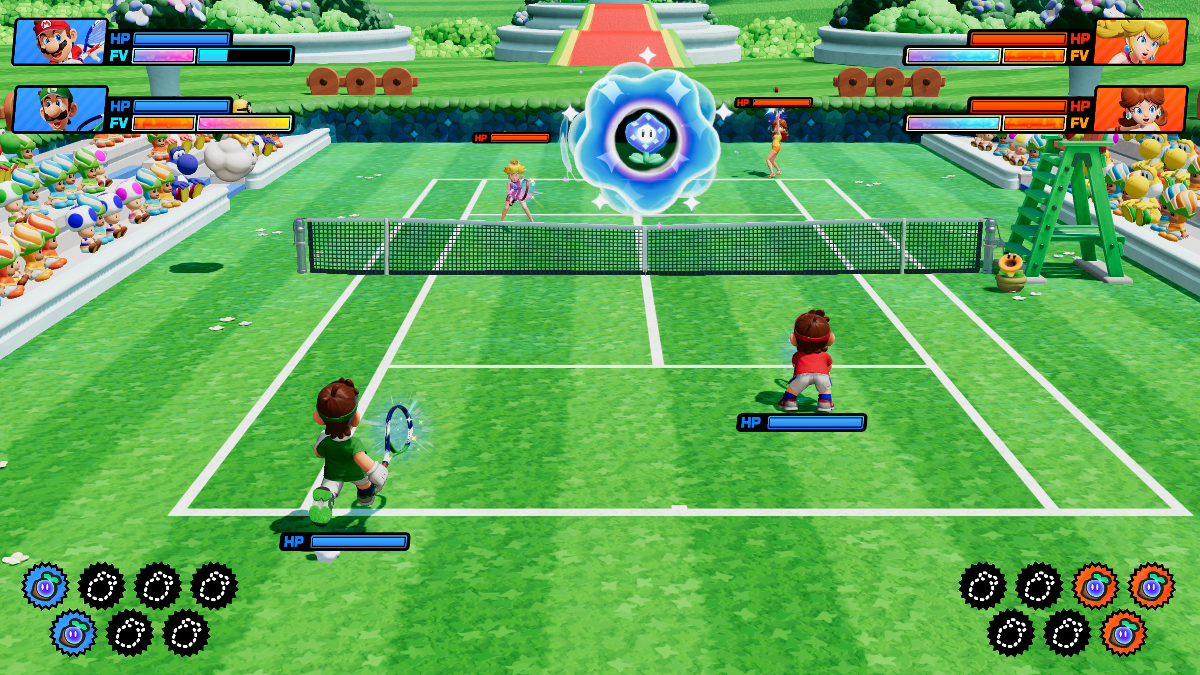
Outside of Free Play, you can try Tournament, Trial Towers, Swing Mode, and Mix It Up. Tournament is essentially an arcade mode where you take on several challengers in a single-elimination tourney, in either singles or doubles. It’s not bad. Trial Towers asks players to climb a tower, completing multiple bite-sized challenges without failing three times. This isn’t the most thrilling mode, but it forces players out of their comfort zone and exposes them to different characters and rackets. Swing Mode is a motion-control mode where the Joy-Cons react to your swinging motion. It’s just a less accurate, clumsier version of tennis.
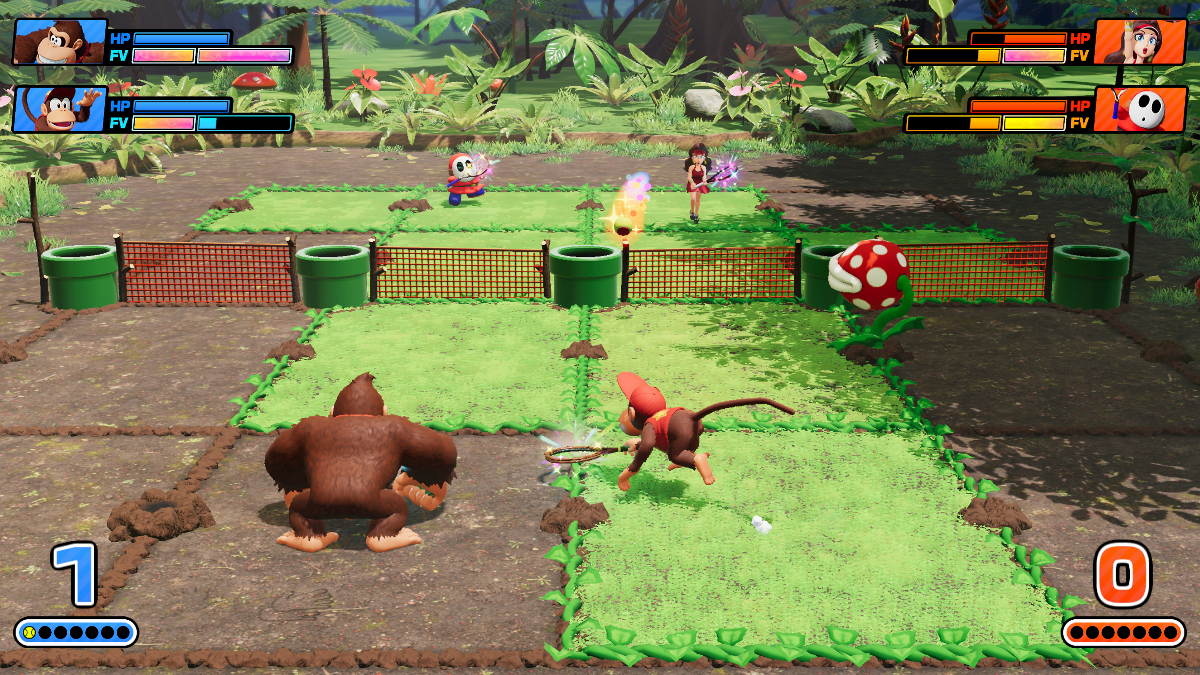
Finally, Mix It Up offers several matches with unconventional rules. Most of these thrill for a few rounds, but lose their novelty rather quickly. There’s the classic Ring Shot, where you must hit balls through suspended, moving rings to earn points, and the brand new Wonder Court Match, where players trigger Wonder Effects inspired by Super Mario Bros. Wonder. The best of the bunch, though, is Forest Court Match, where players can actually expand the size of the opponent’s court in real time, by feeding Piranha Plants at the net with tennis balls. This is one the most exciting, breathless experiences in Fever, since you’re trying simultaneously to land winning shots and keep your own court from getting larger.
There are also online modes: Online Room, a low-stakes mode with custom house rules; and Ranked Match, where you battle other players from around the world for bragging rights and ratings. Ranked Match keeps track of your skills in four different categories: singles with Fever Rackets; singles without; doubles with Fever Rackets; and doubles without. Note that all rankings are recalculated when a new month begins.
Because of all these offline and online modes, Mario Tennis Fever is a good value proposition — as long as you’re willing to put in the time to master all the characters and rackets. It will take you roughly 15 hours to complete everything and unlock all achievements, but you could, in theory, play the game for dozens of hours if you have a reliable friend group, either locally or online.
On the subject of unlocks, Fever deserves a special mention for the way it distributes new characters, rackets, courts, and skins. Instead of offering everything from the start, or delivering new items based on a timer, the game offers hidden content that players can unlock themselves by accomplishing some task or reaching a benchmark. Not only that, but the unlock criteria is quite varied. Sometimes you’ll earn something special by trying a new Mix It Up Match, sometimes you’ll earn something by winning a tournament, and sometimes you’ll earn something just by playing 50 matches. It encourages you to fully explore the game, and gives you something to work toward. It feels very fifth/sixth gen, in the best way possible. Also, if you’re feeling stuck, you can check the unlock prerequisites from the main menu.
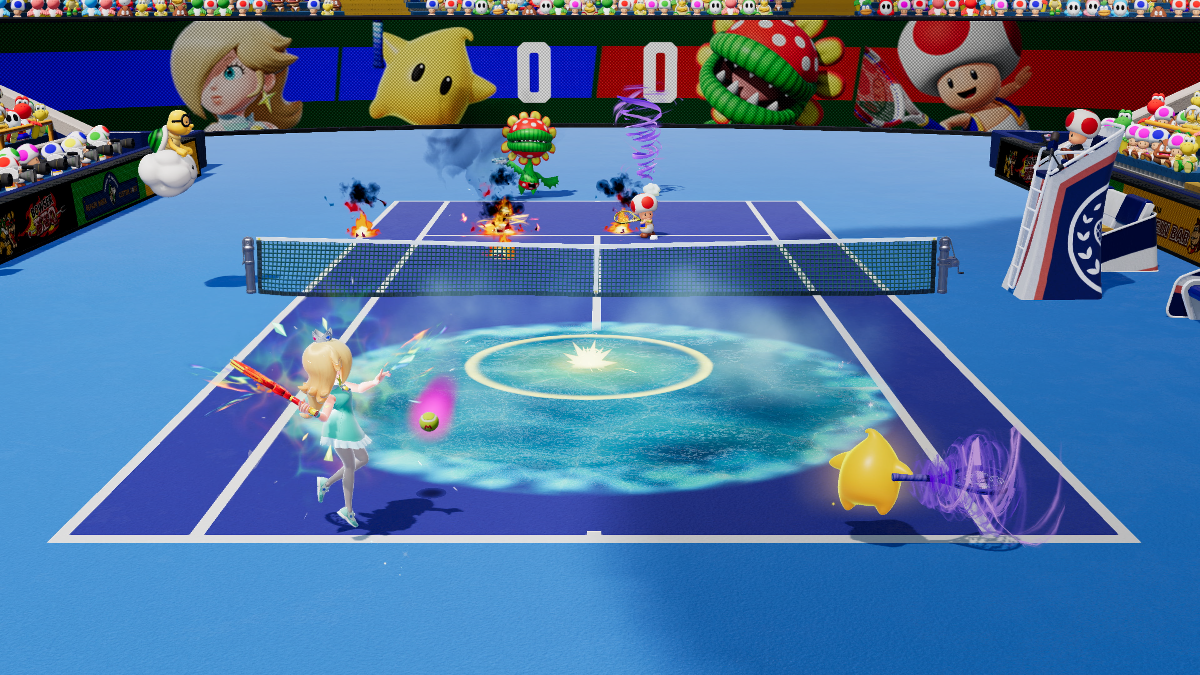
Speaking of the main menu, it’s clean and organized in Fever. And that’s something you can say for all the menus and layouts in the game. As for the in-game graphics, they’re bright, colorful, and bouncy, with smooth animations and eye-catching special effects. The game certainly isn’t maxing out the power of Switch 2, but it looks quite nice. And it maintains a silky 60 fps, even with multiple Fever effects activating at once. Also, the load times are shockingly fast. As for music and sound, things are good, but not particularly memorable. Some people have complained about Talking Flower’s live commentary during matches, but it’s not that bad. It just needs more variety.
Ultimately, Mario Tennis Fever occupies the same general territory as recent Mario Tennis games. It’s good, but not great. The moment-to-moment gameplay is exciting, Fever Rackets add chaotic, unexpected fun to each match, and the huge roster encourages lots of experimentation. Yet the game falters somewhat when it comes to modes, particularly single-player modes. Adventure Mode, if you can call it that, is a letdown, and several complementary modes get stale after a while. Still, the fundamentals are rock solid. If you’re looking for another title to slot into game night, or if you’re serious about climbing the rankings online, this is a smart investment.
Full Article – https://www.vgchartz.com/article/467176/mario-tennis-fever-ns2/
