

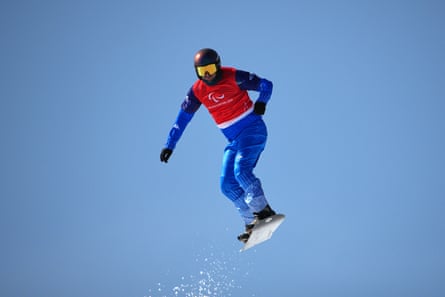
From their vantage point to the south of the San Zan course, the first sight spectators see of the snowboard cross are figures punching through the horizon. Coming off the back of a left‑hand turn, racers come into view as they make the first of a series of jumps in what is also, perversely, a part of the course where you can pick up speed. The moment is over in a split second, as athletes disappear once again behind safety fences. The impact on the gathered crowds is undeniable though: they can’t help but let out a roar.
Snowboard cross is a sport with high technical demands, as athletes negotiate a series of challenges from – to adopt the lexicon – jumps and berms to rollers and drops, all along a winding course. But all this skill is subordinated to the generation of speed. Every movement is calculated to limit resistance and drag. Add the challenges to balance and navigation that come from racing with a physical disability and it is perhaps not surprising to find that the snowboard cross finals at the Winter Paralympics on Sunday were carnage.
The Australian Amanda Reid, a Paralympic swimmer and gold medal-winning cyclist making her debut as a snowboarder, was taken to hospital after crashing out backwards during the heats of the women’s LL1 classification (denoting a more impactful lower limb disability). When treated on the side of the course Reid was conscious and able to speak with paramedics. Great Britain’s Davy Zyw was also taken to hospital as a precaution after he crashed on Daytona Corner. Zyw has motor neurone disease and is understood to be the first snowsport athlete to compete with the condition at the Paralympics. Having watched a video of his crash, friends and family believed a lack of upper body strength caused by the disease left him unable to steady himself in the critical moment. There were also crashes between two racers in the men’s LL1 final and three in the “small final” of the men’s upper limb disability category. It was a lot to take in.
To watch Paralympic sport is sometimes to marvel and boggle alternately at the risks these athletes are willing to take. The explanations as to why can be intensely personal, as with Zyw who was diagnosed with MND seven years ago and told he had three years to live. There are more universal reasons, however, and they were apparent too.

The biggest cheers of the day came in the penultimate race when Italy celebrated gold in the men’s LL2 classification (the less severe of the two lower limb categories). Emanuel Perathoner absolutely smashed the field, beating the Australian Ben Tudhope by more than three seconds.
The 39‑year‑old Italian is a former Olympian, who competed in Pyeongchang eight years ago. His preparations for the following games in Beijing were ended by an injury that forced him to have replacement surgery on his left knee. By 2025 he was world champion in the LL2 category of parasport and has said he sees no difference between the two categories of athlete. Speaking under blue skies in Cortina, Perathoner shared what passed through his head as he crossed the finishing line. “I thought: the last four years have been totally worth it,” he said. “All the work that I was putting in, and all the travelling, all the time away from home, it was totally worth it.”
Equally effusive was the French snowboarder Cécile Hernandez, who retained the title in the women’s LL2 classification at the age of 51. Collapsing to the ground in delight when she crossed the finishing line, Hernandez said she was delighted to have won with her daughter among the crowds. “It’s incredible and I still can’t realise what happened,” she said. “I’m very, very, very proud. My daughter is here, and my dream was to see some tears, but tears of joy in my daughter’s eyes and on her face. I did it, and this medal is for her.”
Hernandez’s daughter would have found herself amid a party atmosphere as she watched her mother race. An apres-ski vibe in the middle of the day, there was colour and enthusiasm everywhere and from some unlikely places.
Alongside the Scottish crew with Zyw on their royal blue beanies, there was a substantial Lithuanian contingent there to watch Rapolas Micevicius, their first winter Paralympian in 32 years. He went out of the LL2 category in the quarter-finals but the party went on regardless; there was always another group of ferociously dedicated daredevils coming over the hill in just a few minutes after all.
