

The siren that warned a ballistic missile launched from Iran might be heading towards RAF Akrotiri sounded just as the defence secretary, John Healey, had sat down in a secure room on the base, preparing for the day’s Cobra meeting with the prime minister and cabinet.
It was the second time the alert had been sounded that day, a sound that has driven many local people to leave the area in fear. When the siren blares, any officer or soldier out in the open air dons body armour and helmets and lies on the ground. Healey simply pressed mute on his video briefing.
“The general advice is just to move away from windows,” Healey smiled, standing in the bright winter sunshine on the apron next to an F-45 jet and a Typhoon.
“I was already in a windowless room. But it’s a reminder of the increasingly indiscriminate threat that Iran poses as we’ve seen from their first retaliatory strikes. Countries that are not involved in the conflict, civilian as well as military targets. It’s why we’re stepping up now.”
Each time the all-clear has come quickly: the missile has gone up, but military intelligence quickly establishes the trajectory is not towards Cyprus. But each time the siren went off, it was a reminder just how close to the frontline the base is – and why British troops here could be a target.
It has also terrified local people, many of whom have left the surrounding towns, and provoked anger at the lack of preparedness for the US-Israeli attacks on Iran and what they may provoke.
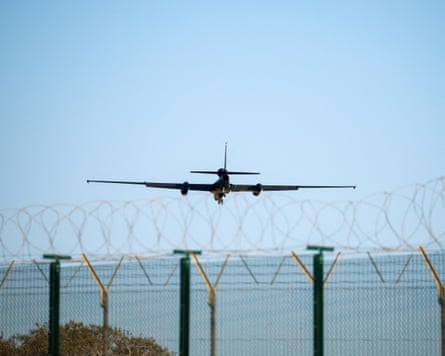
The base is usually a hive of activity with 4,000 people, military personnel but also teachers, chefs, civilian personnel and families.
In one of the rooms on the base where journalists gather to wait for Healey’s arrival, there are huge sheets of paper scrawled with children’s drawings, where families on the base had waited to be evacuated after a drone evaded the base’s defence systems on Sunday night.
Families have moved to temporary accommodation in Paphos in the west of the island, as have catering staff. Stores have closed and the base is on its highest alert.
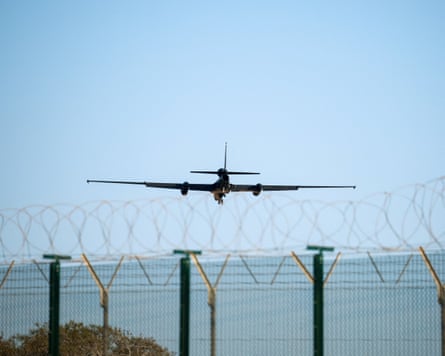
The drone that military officials believed was fired by the pro-Iranian militia Hezbollah in Lebanon hit an uneasy target – a hangar housing American U-2 spy planes. It is an indication that whoever fired it knew and understood it was aimed at a deliberate target.
Healey and the UK have faced significant questions from the Cypriot government about why the base and the island were not better defended.
Two wildcat helicopters will arrive at the base overnight, with more sophisticated air defence and detection systems that will be better equipped to spot the small slow-moving drones such as the one that evaded the systems on Sunday night and crashed into the hangar – leaving a 3ft hole.
Small though it might be – the size of a labrador puppy – the damage it did would have certainly caused casualties if it had hit a room on the base with people inside.
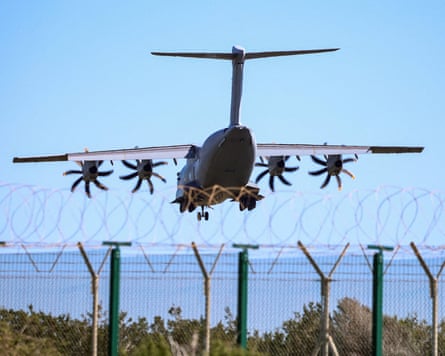
The base has the highest concentration of British military personnel closest to the war across the eastern Mediterranean from Israel and Lebanon. Looking up at the cloudless night sky, you can see the pinprick light of missiles.
The military presence in Cyprus is set to increase significantly, with warships on their way or already present from France and Greece, to be joined by a British ship next week – all of which will bolster the island’s air defences.
As yet, there is no clear collaboration or command, which is the next focus for the leadership of the base here.
Much of the past few days has been spent soothing nerves of the Cypriot government, which Healey met in Nicosia on Thursday morning. For now there is no threat to the future of the base, though local protests have been gathering to express anger at the British presence.
As Healey returned to the vehicles after meeting troops by the jets, the sirens sounded again. The convoy started to move at great speed, passing troops in helmets taking cover behind whitewashed walls. Again, it was a false alarm, the trajectory of the missile was not towards the base.
There is a sense among officials that given one drone evaded detection, it is better to alert with an abundance of caution – meaning there are a lot of false positives. But the constant squawk of sirens will only add to the impression for many of the Cypriots living near the base that the war is on their doorstep.
